Published June 2026. Each month through the Peruvian winter we publish what the climate and trade data say about the coming mango harvest. As a dried-mango producer and exporter from Piura, we watch the chill nights that set next season's crop, because they decide both how much fresh fruit reaches the market and how much raw material reaches our dryers. This first note covers what May leaves us with, and why the early signals are concerning.
The one-line read: the 2026/27 Peruvian mango campaign is, so far, tracking the warm lead-in that preceded the 2023/24 collapse, the worst harvest in the modern record. It is early, the picture can still change, but buyers planning Q4 should be watching this closely.
1. Why mango buyers should care about cold nights in Piura
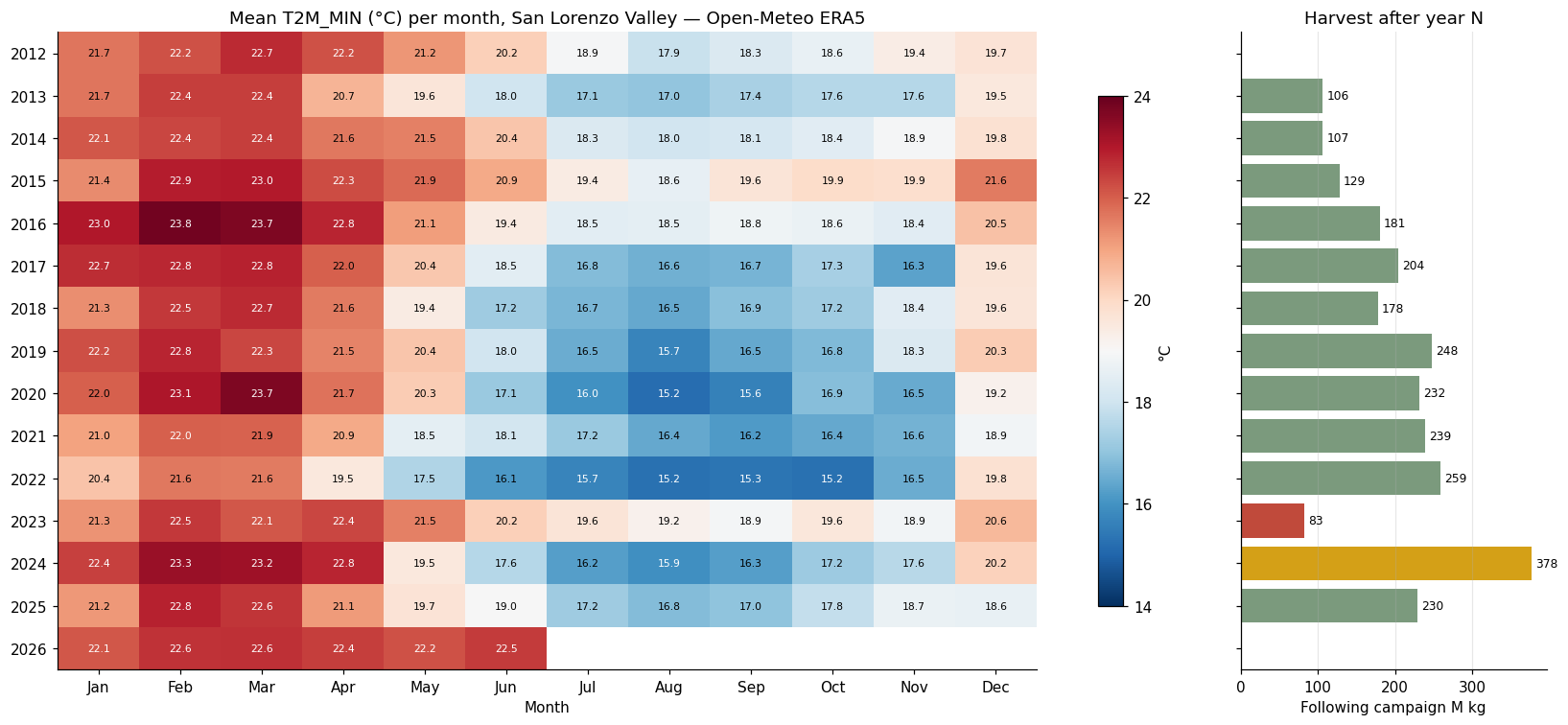
Peru's export mango (mostly the Kent variety) flowers only after a spell of cool nights during the southern-hemisphere winter. The canonical biological trigger is an overnight low at or below 18 °C in June, July and August. No cold, no flowering; no flowering, no fruit. This is not folklore, it is the single strongest predictor in our model: across the last twelve completed campaigns, each extra June–August chill night is worth roughly 1.7 million kg of national export volume (R² = 0.54).
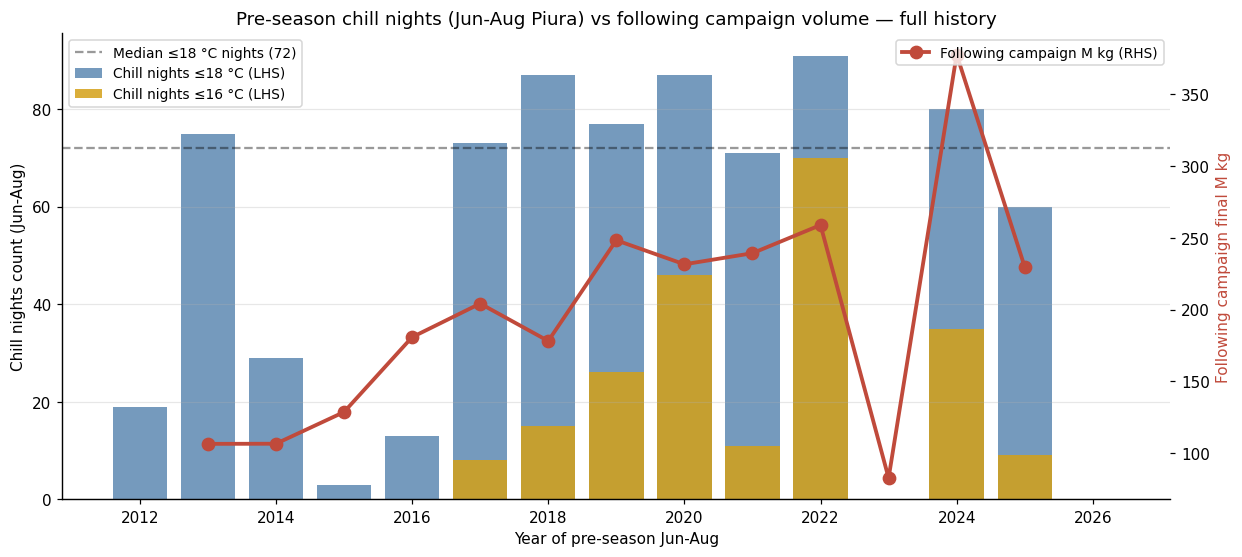
Plotted as a single relationship, the slope is easy to read: cool pre-seasons (2019, 2024) line up with big harvests, warm ones (2015, 2023) with small.
2. What the data shows right now
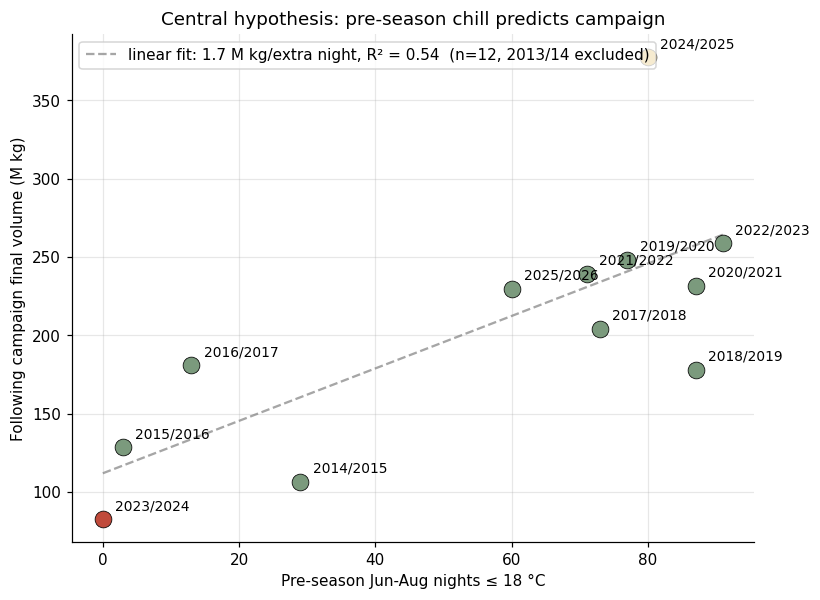
Zero chill nights, and the warmest lead-in on record. Through the first week of June we have logged zero nights at or below 18 °C across the 32 days from 1 May, with a mean overnight low of 22.2 °C. The historical median for that same May window (2014–2025) is 13.5 chill nights and 19.3 °C. We are running close to 3 °C warmer than a normal lead-in, and we have not yet had a single cold night. May does not count toward the official June–August chill window, but a Piura still running this warm in May rarely flips to a cold winter.
The ocean keeps warming. The Niño 1+2 index, the sea-surface temperature anomaly in the patch of Pacific directly off Peru's north coast, read +1.81 °C in May, up from +0.89 °C in March and +1.31 °C in April. On 29 May, Peru's ENFEN commission maintained its Alerta de El Niño Costero and now expects the coastal warm anomaly to persist at moderate magnitude through February 2027, covering the entire 2026/27 campaign, with above-normal coastal air temperatures through the June–August flowering window.
3. How worried should we be? The 2023/24 comparison
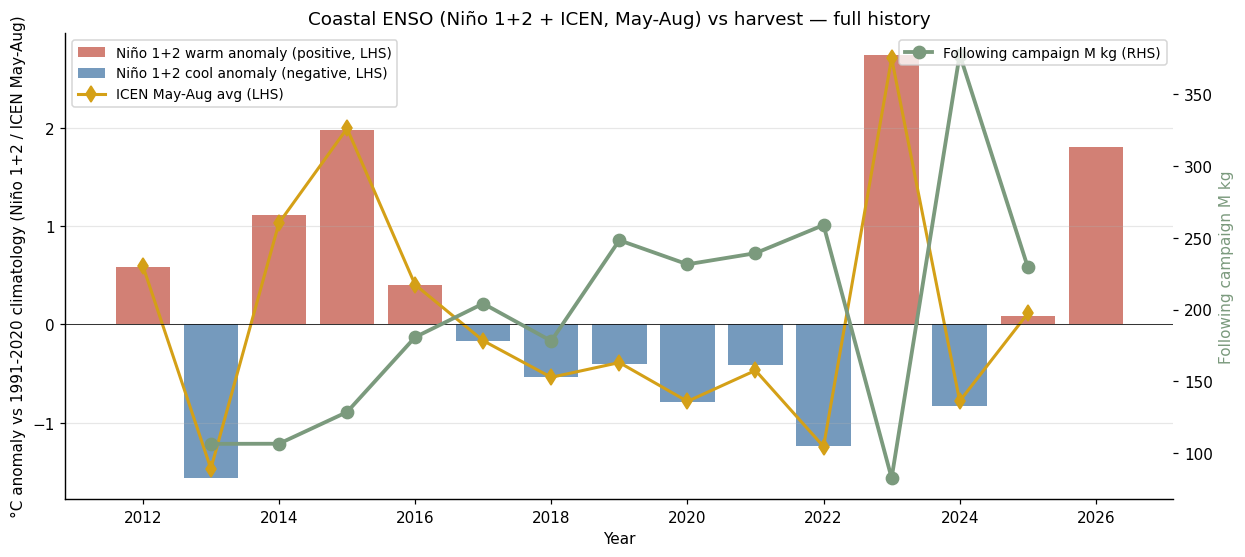
Clients ask about 2023/24 specifically because the export collapse from 263 M kg (2022/23) to just 83 M kg (2023/24) was the largest single-year drop in the modern series. Comparing the two seasons at the same point in the calendar is the most direct test of the analogy.

The reading is genuinely two-sided, and we will not overclaim it. On the warning side, 2026's mean May low of 22.2 °C is actually warmer than 2023's 21.4 °C at the same point, and the coastal warm anomaly is still strengthening into the chill window rather than fading as it was in 2023. On the reassuring side, ENFEN forecasts moderate rather than strong magnitude, and 2026 has had far less of the heavy Niño Costero rainfall that compounded the 2023 damage. So: a worrying setup, not a foregone conclusion.
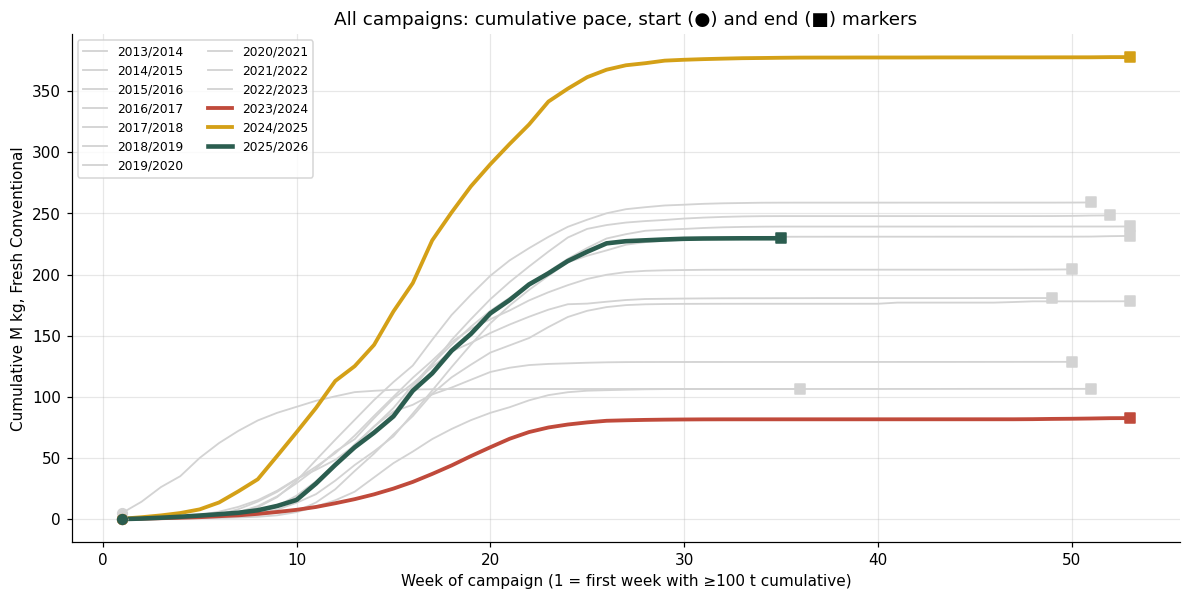
The clearest way to see what a collapse, a normal year and a record look like is the week-by-week export build from October to May. The collapse line never lifts off the floor.
4. The number behind the "record" that buyers should understand
It is tempting to look at the 378 M kg "record" of 2024/25 and assume Peru can simply repeat it. The data says otherwise. Most of the decade's volume growth, from ~106 M kg in 2013/14 to 378 M kg in 2024/25, is area expansion, not better yields. Normalised to yield per hectare, normal years cluster tightly around 6 t/ha, the 2023/24 collapse fell to under 2 t/ha, and the 2024/25 "record" was a normal ~9 t/ha applied to a third more planted area. Removing the area effect, chill nights explain yield even more tightly (R² = 0.78).
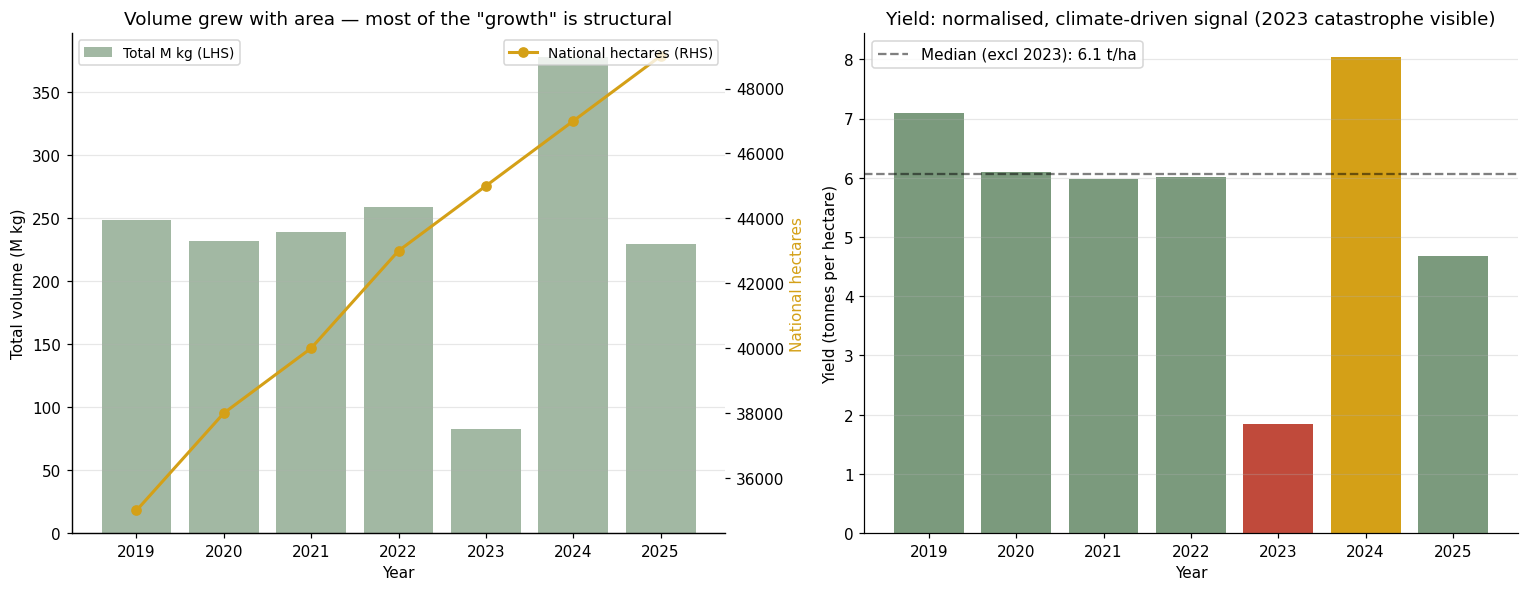
Why this matters for 2026/27: with a current planted-area estimate near 51,000 ha, a normal chill winter would point to roughly 305 M kg, while a 2023-style warm winter points to roughly 98 M kg, a collapse. The Jun–Aug chill outcome decides which, and right now we are at the warm end.
5. Peru mango in focus, and the dried-fruit angle
This is where it gets practical for Villa Andina's customers, because we make dried mango, and dried supply is downstream of the fresh harvest. When fresh fruit is scarce and expensive, the raw material for dehydration tightens with it. The customs record shows this clearly: Peru's dried-mango exports rose steadily to ~920 tonnes by 2023, then fell to 384 tonnes in 2024 as the 2023/24 fresh collapse starved the dryers, before rebounding sharply to ~2,350 tonnes in 2025 on the back of the abundant 2024/25 fresh crop.
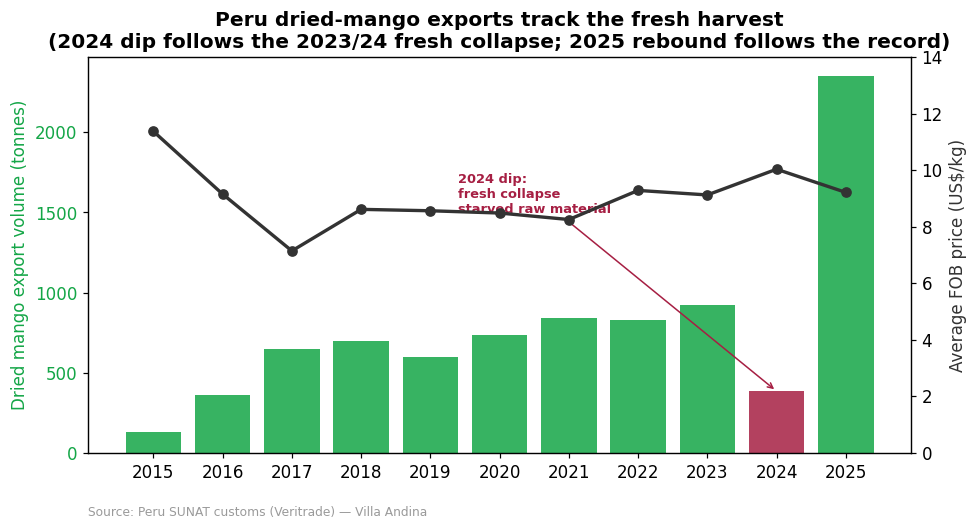
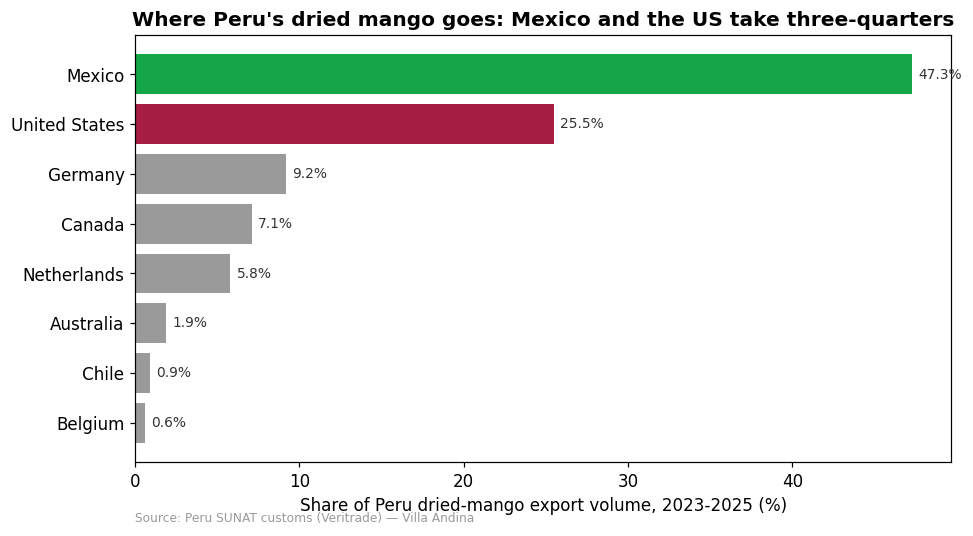
So a short 2026/27 fresh campaign would not only lift fresh prices, it would tighten dried-mango availability and firm dried prices into 2027. Dried-mango demand is concentrated: over 2023–2025, Mexico (47%) and the United States (25%) took three-quarters of Peru's dried-mango exports, with Germany, Canada and the Netherlands the main European and North American buyers.
6. What the market is already pricing
The 2025/26 fresh campaign closed in late April at an average USD 2.66/kg FOB across 229 M kg, a normal-to-light year, above the recent norm but well below the 2023/24 collapse year's USD 3.00/kg. There is no liquid forward market for Peruvian mango, so no single "2026/27 price" exists yet, but the latest 30-day FOB on residual May shipments is already running near USD 3.69/kg, above the closing average and a sign the market is leaning cautious before the chill window even closes.
7. What this means for your planning
Three practical takeaways, with the clear caveat that this picture will sharpen a lot over the next eight weeks:
- Treat 2026/27 as elevated collapse-risk, not a base case. The lead-in is warm and the ocean signal is rising, but the decisive Jun–Aug chill window has only just opened. The single most useful thing to watch is whether cold nights arrive in July.
- Dried-mango buyers should plan as carefully as fresh buyers. A short fresh harvest transmits to dried supply with a lag, as 2024 showed. If you have 2027 dried-mango needs, building a view now, while there is still time, beats reacting in Q1.
- Switching origin is about availability, not cheaper fruit. When Peru is short, US wholesale rises across origins, including Mexican-origin fruit, so an alternate origin solves availability rather than cost.
We are an organic dried-fruit and superfoods producer from Peru, working directly with Piura farming communities. You can explore our dried mango, our wider dried fruit range, and our full product list.
Frequently asked questions
Will Peru's 2026/27 mango harvest be short? It is too early to say with confidence, but the early signals point that way: zero chill nights so far in Piura against a median of about 13, the warmest May lead-in on record, and a strengthening coastal El Niño. A normal winter would point to ~305 M kg, a 2023-style warm winter to ~98 M kg. The June–August chill window decides it.
What is El Niño Costero? A warming of the ocean specifically along Peru's north coast (the Niño 1+2 region), distinct from the basin-wide Pacific El Niño. Peru's ENFEN commission declares it using the ICEN index. Warm coastal waters suppress the cold nights mango needs to flower.
Why do cold nights matter for mango? Kent mango flowers only after a spell of nights at or below about 18 °C in winter. Without that chill, the trees do not induce flowers, and the following harvest is small. It is the strongest single predictor of Peru's campaign size.
How bad was the 2023/24 collapse? Exports fell from 263 M kg to 83 M kg, the largest single-year drop in the modern series, on a warm winter with effectively zero chill nights and heavy Niño Costero rains.
Does a short fresh harvest affect dried mango? Yes. Dried mango is made from fresh fruit, so a short fresh crop tightens the raw material for drying. Peru's dried-mango exports fell sharply in 2024 after the 2023/24 fresh collapse, then rebounded in 2025 with the larger fresh crop.
Key terms
Chill nights. Nights with an overnight low at or below 18 °C in Piura's winter, the trigger for Kent mango flowering. We track them daily at the San Lorenzo Valley grid cell using ERA5 reanalysis data.
Niño 1+2. The sea-surface temperature anomaly off Peru's far-north coast. A fresh monthly snapshot of coastal ocean warmth.
ICEN. The smoothed three-month version of the coastal index, used by Peru's ENFEN to officially declare an El Niño Costero.
ENFEN. Peru's multi-agency commission that monitors El Niño and issues the official coastal-El-Niño alerts and forecasts.
Floral induction. The biological process, triggered by cool nights, by which a mango tree forms the flowers that become fruit.
FOB. Free On Board, the price of fruit loaded at the Peruvian export port, before freight and insurance.
Campaign. A mango export season, running roughly October to April/May of the following year.
Methods and limits
The chill-nights analysis uses twelve completed campaigns (2014/15–2025/26) of national Peru customs data (SUNAT via Veritrade) and ERA5 daily minimum temperature at the San Lorenzo Valley grid cell. The model is directional, not precise: with twelve data points it distinguishes a collapse from a normal from a record year, not a number to the nearest 20 M kg. ENFEN figures are from Comunicado Oficial N° 10-2026 (29 May 2026). The heatmap below shows how Jun–Aug overnight lows (blue = cold, red = warm) line up with the following harvest, year by year.
This article is general market information, not investment advice. Climate forecasts carry real uncertainty and the June–August chill window is still open. Figures are as of 7 June 2026. Peru export statistics are from SUNAT customs records via Veritrade; climate data from ERA5 (ECMWF), CHIRPS and Peru's ENFEN.