Cocoa has fallen 20% from its late-August high while the next West African crop looks worse by the week, and Peru's own El Niño is forecast to bring early rains to the north coast from November. This is Villa Andina's September read: a one, three and six-month price forecast, what the crop reports and our own satellite data say about West Africa, and the 2026 numbers behind Peru's cacao exports. It follows our June outlook.
1. The forecast: where cocoa prices are heading
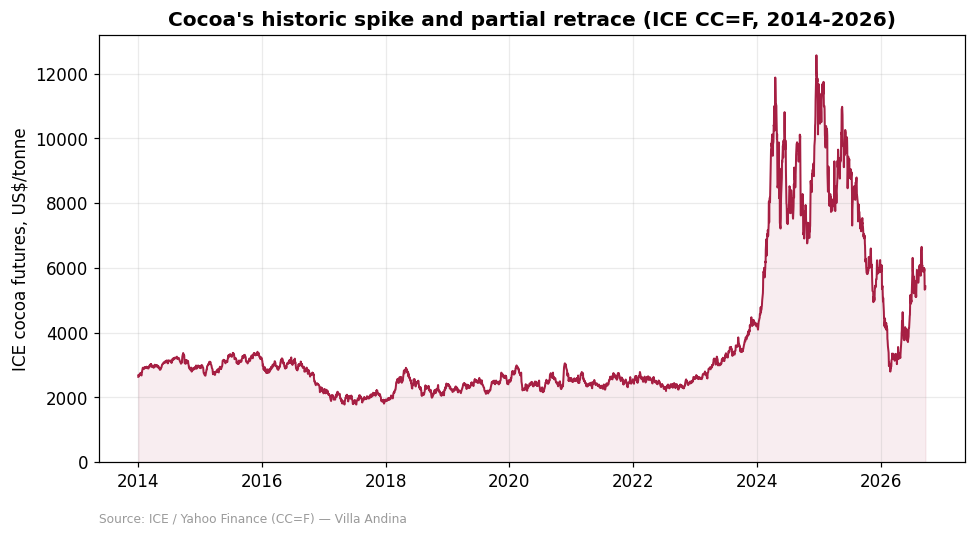
ICE New York cocoa futures closed at US$5,307 per tonne on 21 September 2026, down 11.5% in a week and about 20% below the 11-month high of US$6,650 reached on 31 August. Prices are still up 17% over three months and roughly half the 2024 record near US$10,000.
Our view across the three horizons:
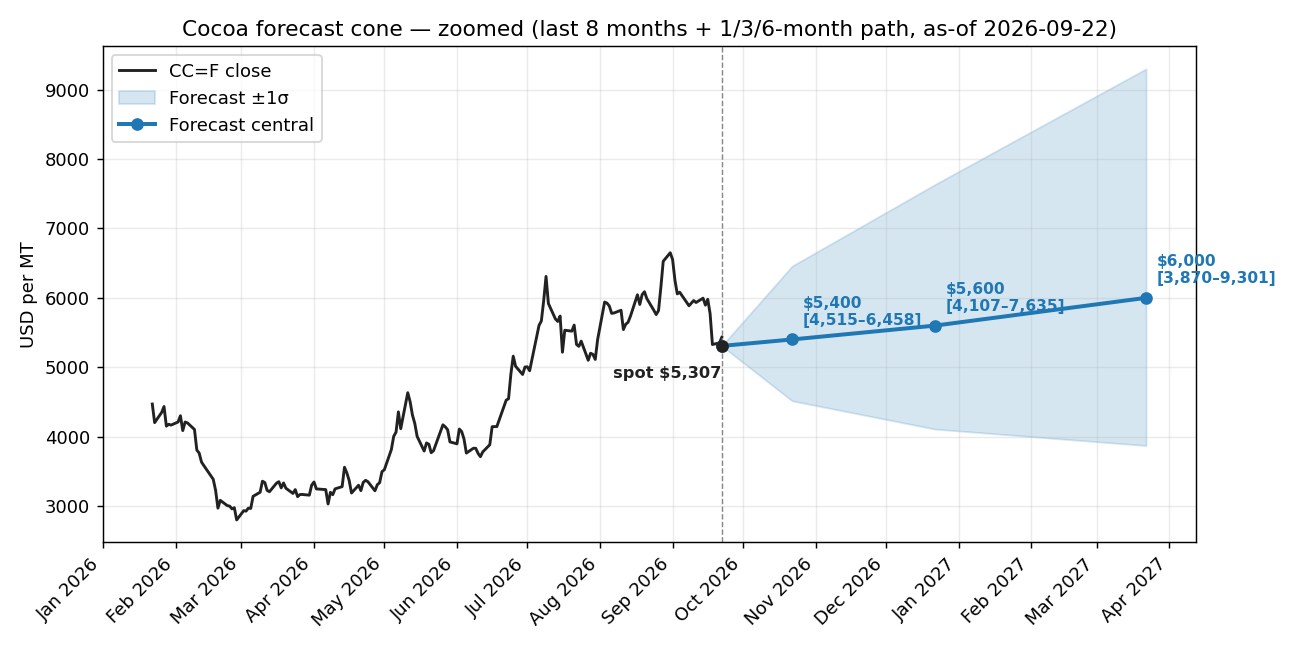
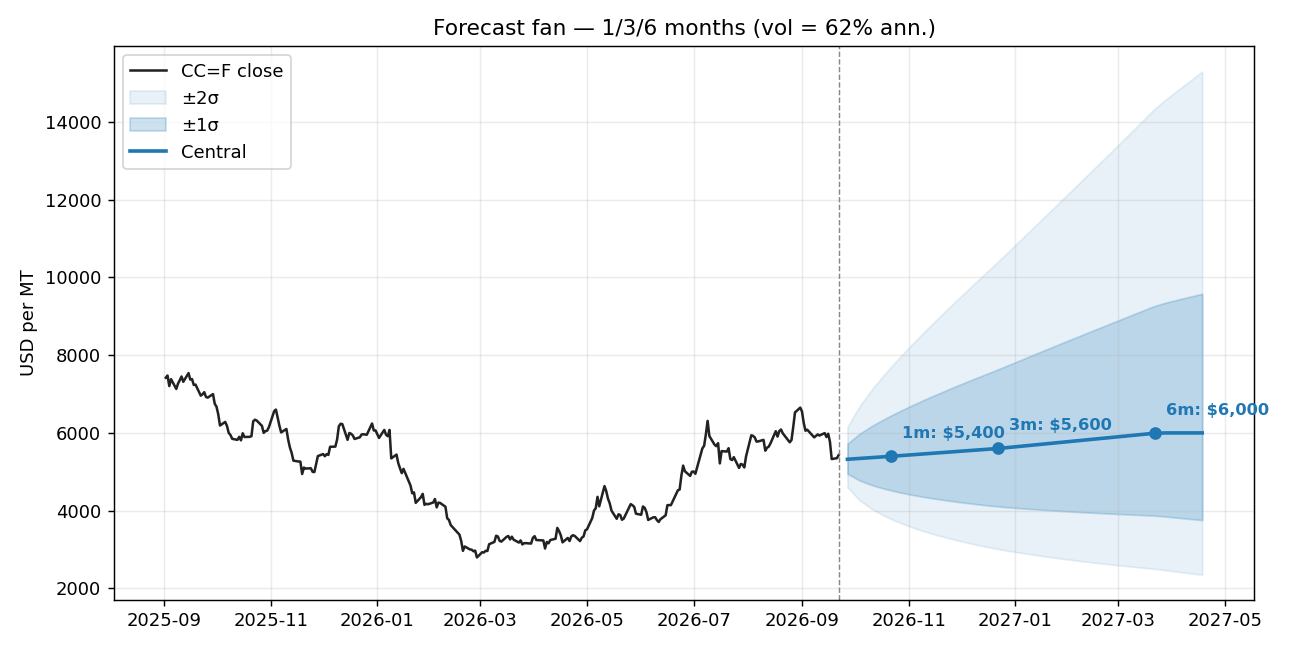
One month (to late October): roughly US$4,500 to US$6,450, still heavy but close to the floor. The harvest that just ended was large, exchange warehouses are the fullest in two years, and speculators are not positioned in a way that would force a sharp rebound. After a 20% fall, most of that is already in the price.
Three months (to late December): roughly US$4,100 to US$7,600, and this is where the picture can turn. The first hard numbers on the new West African harvest, the third-quarter demand figures and the start of the Harmattan all land inside this window.
Six months (to late March): genuinely two-sided, either near US$4,200 to 4,700 or US$8,500 and above. A very strong El Niño on top of an already downgraded crop points to the high side. A wet year that still delivers volume, with full warehouses as a cushion, points to the low side. We would not plan around the middle.
The most important idea in this report, as in June: the range is the message, not the central number. Realised volatility is running near 62% annualised, and the market is pricing a comfortable present and an uncertain future at the same time.
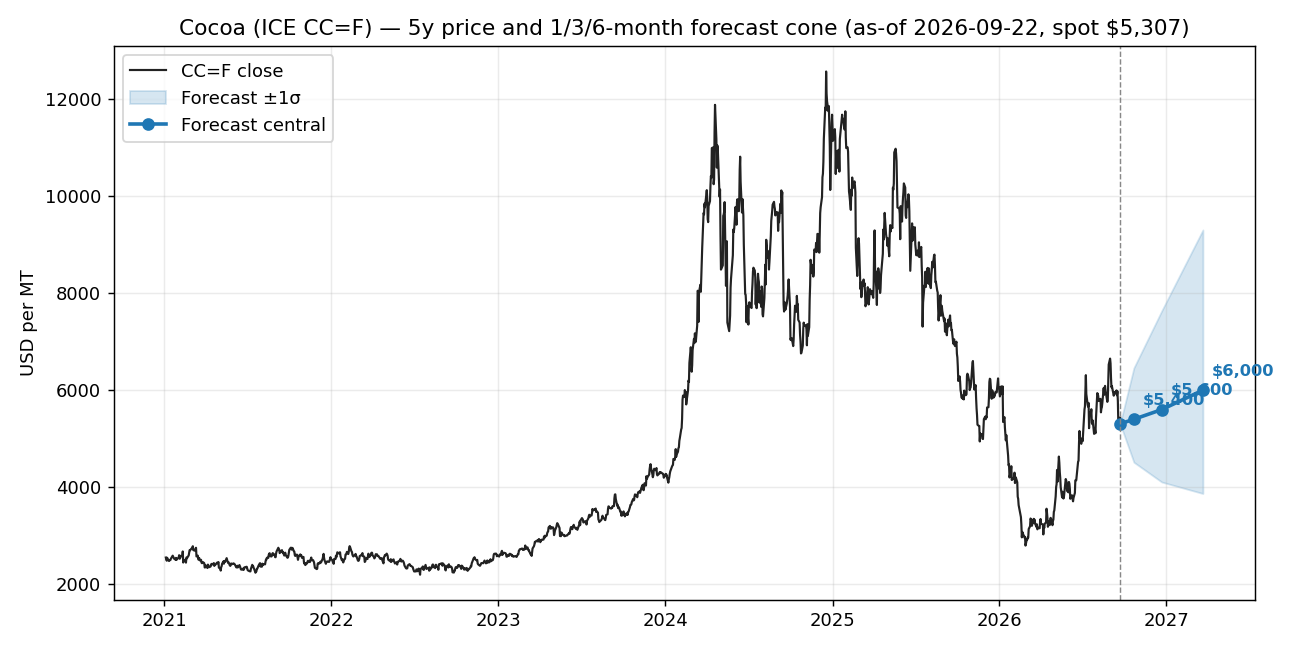
Zoomed in, so you can read the range at each horizon:
2. Two crops, two horizons: what is happening in West Africa
Côte d'Ivoire and Ghana grow about 60% of the world's cocoa, so their harvests set the price. Right now the market is looking at two very different crops at once.
The crop that just ended was big, and that is why prices are falling
Côte d'Ivoire's regulator, the Conseil du Café-Cacao, reported a harvest of about 2.06 million tonnes for June 2025 to June 2026, 30% more than the year before, and cumulative deliveries to its ports reached about 2.14 million tonnes, 18% ahead of the previous season (Barchart via Nasdaq, 17 September). Ghana's 2025/26 crop came in near 750,000 tonnes, up about 26%. Exchange-certified stocks climbed to a two-year high above 3.4 million bags, and Barry Callebaut, the largest processor, described the market as well supplied. The ICCO's August bulletin still shows the 2024/25 season closing with a small surplus.
That is the near-term reality, and it explains the September sell-off: more beans arrived than traders had feared.
The crop that starts in October looks worse than it did a month ago
The 2026/27 main crop, harvested from October to March, is the one that matters for prices into 2027, and every reliable source we have checked points the same way:
Côte d'Ivoire. Pod counters and exporters surveyed by Reuters in July expect the main crop to fall by more than 10%, to about 1.35 to 1.45 million tonnes for the September-to-February core of the season, after heavy rain in May and June killed more than 20% of flowers and young pods and spread black pod disease (Reuters via BusinessWorld, 13 July). StoneX puts the full season near 1.77 million tonnes, down 11% (StoneX, "Cocoa storm gathers"). In the first two weeks of the new marketing year, which now starts on 1 September, deliveries were about 46% below the same period last year. And in the week to 21 September farmers in the main growing regions reported below-average rain and small pods dropping (Reuters via TimesLive, 21 September).
Ghana. The state Cocoa Marketing Company expects 470,000 to 620,000 tonnes, down 18% to 38%, citing old trees, disease and poor pollination (CNBC Africa, 3 September). Swollen shoot virus, which has no cure, keeps eating into the tree stock; a recent study put 15% of Ivorian supply at risk from the same disease (CNBC Africa).
Farmgate prices and smuggling. Côte d'Ivoire cut the price it pays farmers for the new main crop by 57%, to CFA 1,200 per kilo, after last season's beans went unsold at the old price (Ecofin Agency, 2 September). Less income means less fertiliser and less farm care, which weighs on yields a season later. Ghana, meanwhile, plans a rise of about 6%, opening a gap that pulls Ivorian beans across the border (Bloomberg via BusinessMirror, 9 September).
Financing. Ghana's cocoa board owes licensed buyers about US$350 million and is struggling to raise money locally to fund the new season, so the official start may slip (bne IntelliNews, September).
Put together, analysts have cut next season's global surplus to almost nothing. StoneX now sees about 25,000 tonnes, down from 149,000, and at least one large Asian grinder expects a deficit of 300,000 to 400,000 tonnes (CocoaIntel, 2 September). A market that is balanced on paper has no cushion against a weather shock.
What our own satellite data say
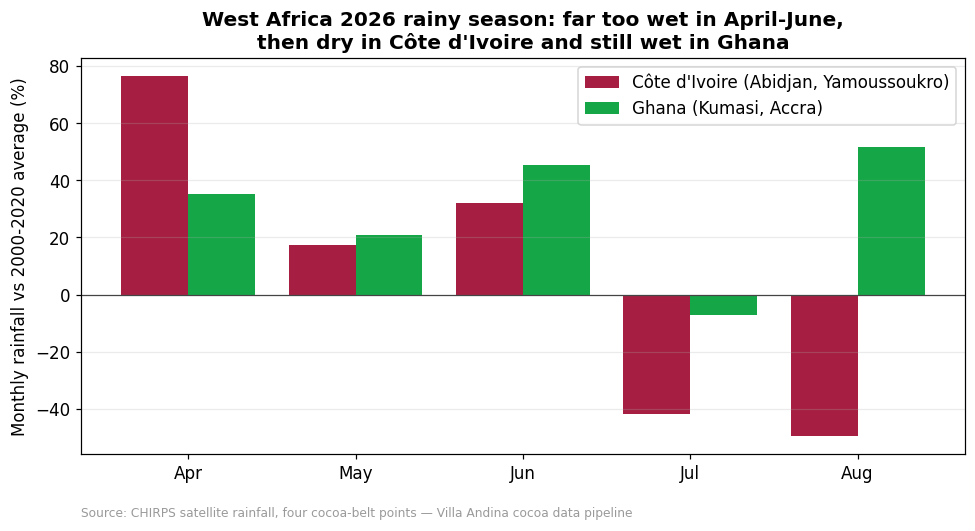
We run a data pipeline that tracks rainfall, soil moisture and vegetation at four points across the cocoa belt (Abidjan and Yamoussoukro in Côte d'Ivoire, Kumasi and Accra in Ghana), plus the ocean indices that drive El Niño. Two findings stand out this month.
First, the rain damage described by the pod counters is visible from space. April to June 2026 was far wetter than normal at every point, up to 77% above the 2000-2020 average in Côte d'Ivoire in April. A recent Harvard and University of Ghana study found that too much rain during flowering, not drought, is the main cause of cocoa shortfalls (Geographical, 16 September), and that is exactly what this season delivered. Since July the two countries have diverged: Côte d'Ivoire dry (about 50% below normal in the 30 days to end-August), Ghana still wet.
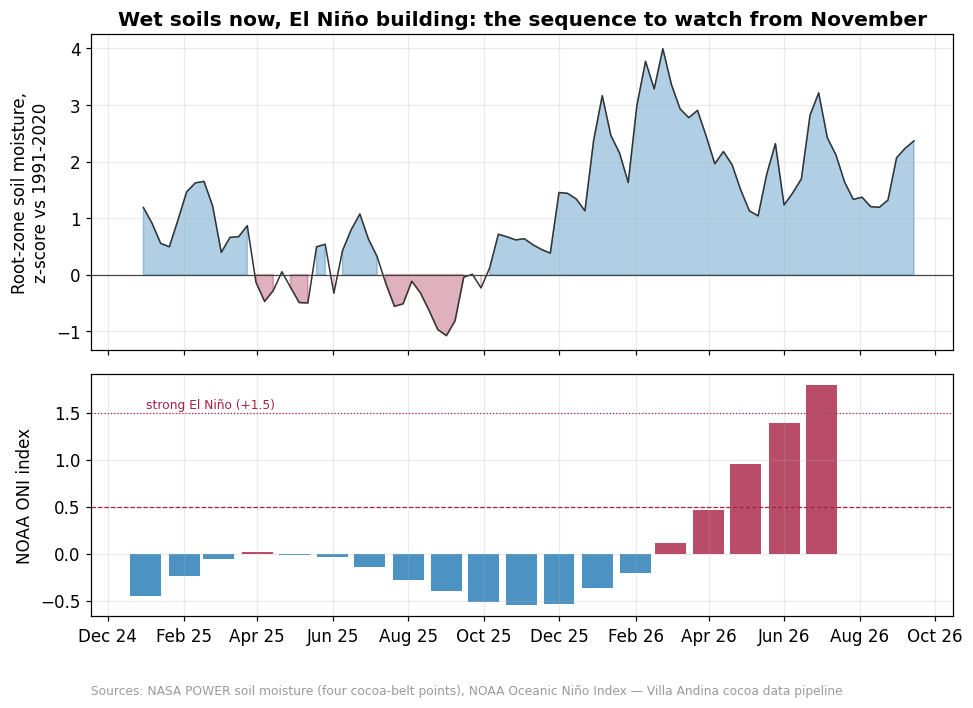
Second, the soils are still very wet, while El Niño is building fast. Root-zone soil moisture across the belt was more than two standard deviations above normal in mid-September, so the mid-September dry spell has not yet stressed the trees. The NOAA index that measures El Niño reached +1.8 for June to August, already a strong event, and NOAA's Climate Prediction Center gives a more than 90% chance of a very strong El Niño this winter and a 75% chance that October to December is the strongest since 1950 (NOAA CPC, 10 September; see also the GFDL model forecast). In West Africa, El Niño years tend to bring a hotter, drier Harmattan from November. Because the soils are wet now, the damage, if it comes, would fall on the pods harvested from January to March rather than on the October crop.
Demand: recovering, but not everywhere
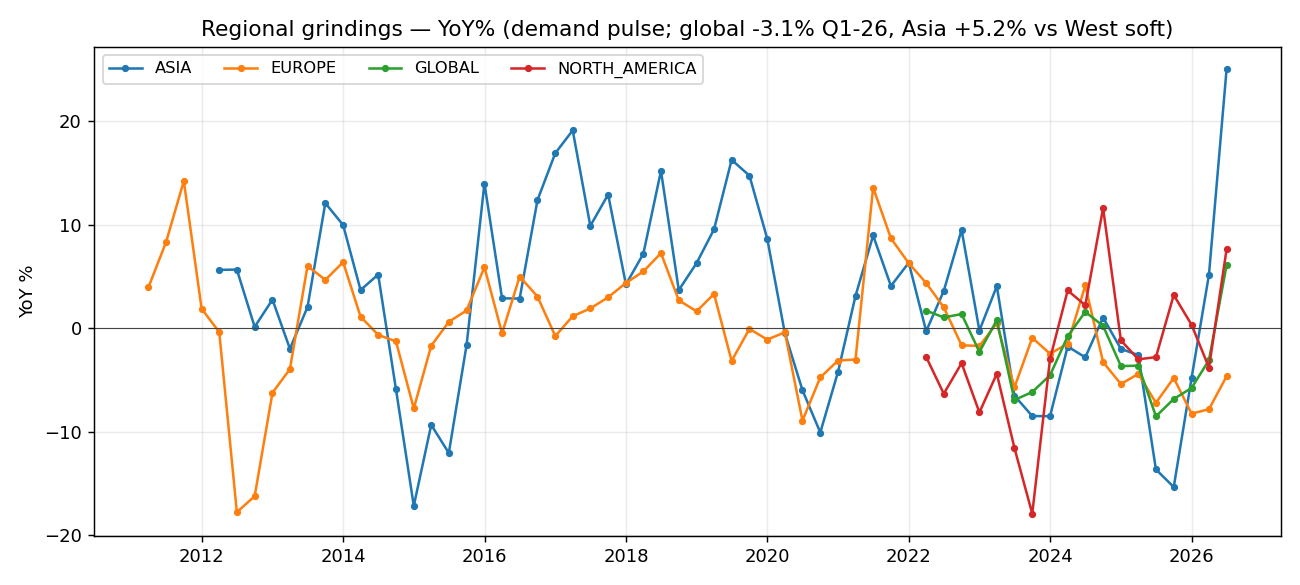
Grindings, the volume of beans processed into liquor, butter and powder and the best read on real demand, turned positive in the second quarter for the first time in more than a year, led by Asia. Europe, the largest grinding region, still shrank by about 4.6%. The third-quarter figures arrive in mid-October and will show whether demand held up at US$5,500 to 6,600 cocoa.
3. Peru in focus: the 2026 numbers
Using Peruvian customs records, here is how Peru's cacao trade looks after eight full months of 2026, and what changed since our June report.
Volume is running below 2025, and the peak came earlier
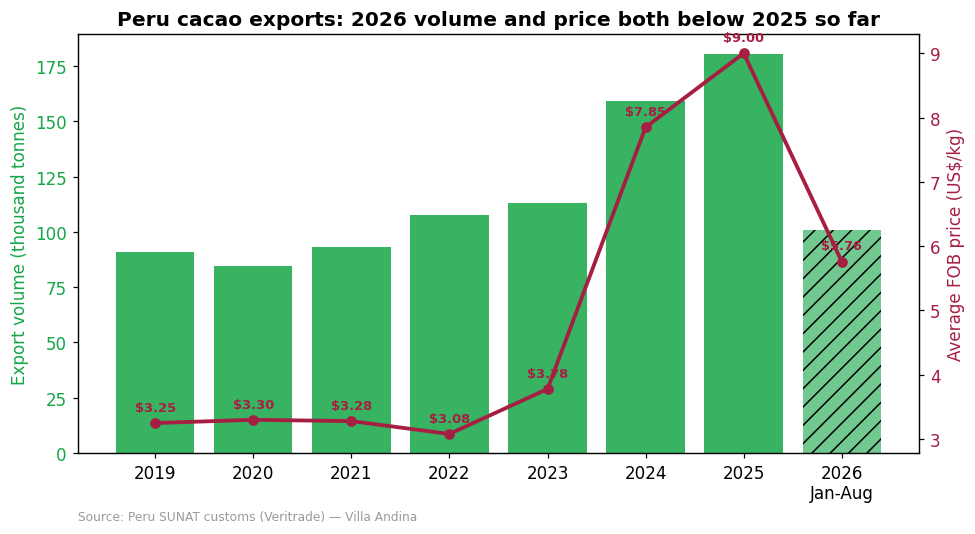
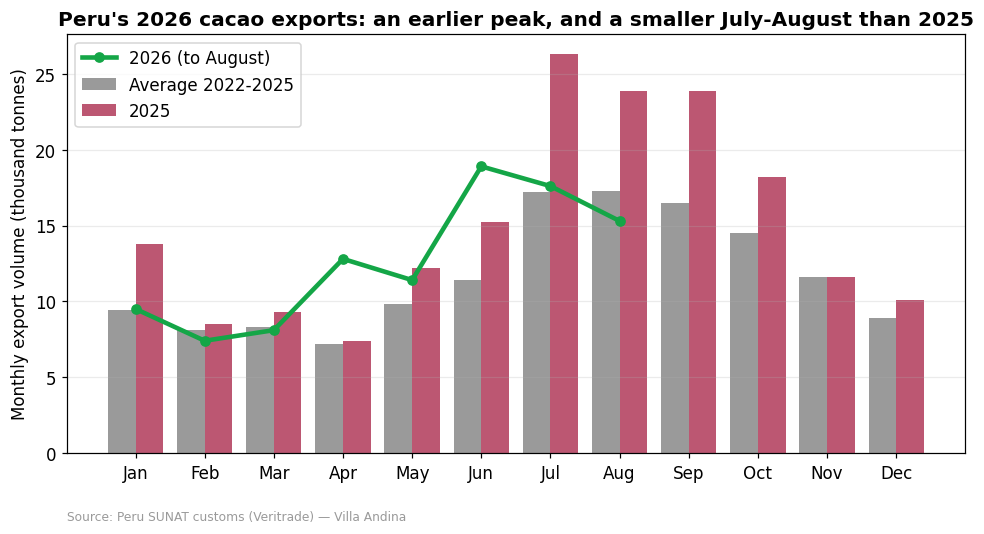
Peru exported about 101,000 tonnes of cacao and cacao products from January to August 2026, 13% less than in the same months of 2025, at an average FOB price of US$5.76 per kilo against US$9.00 last year. The 2025 peak of July to September was exceptional (26,000 tonnes in July alone); 2026 has been closer to the normal calendar, with a strong April to June and a smaller July and August. For buyers that means the post-harvest window is narrower this year, not longer.
Peru's price follows New York, with a lag
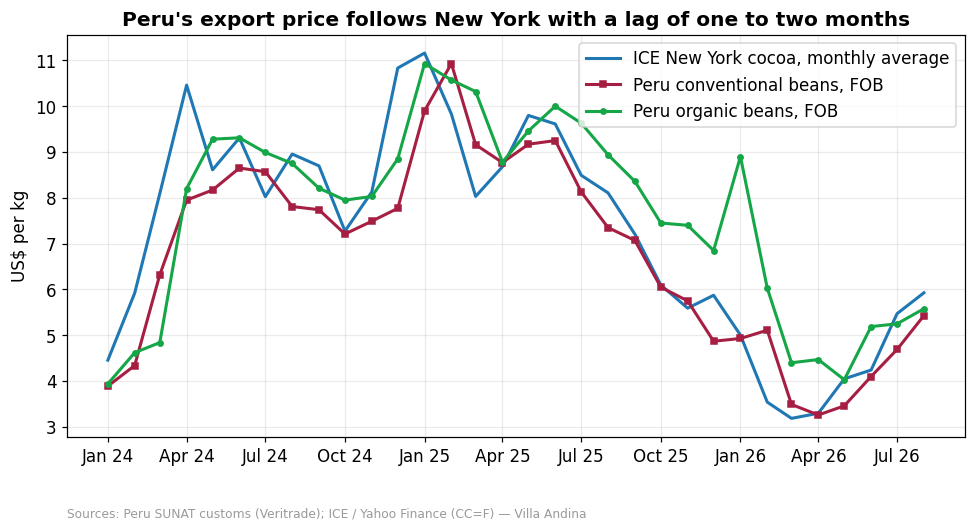
Peruvian bean prices track the ICE futures curve with a delay of one to two months, because most contracts are priced off the exchange when they are signed and ship later. Conventional beans left Peru at US$3.26 per kilo in April 2026 when New York was near its low, and at US$5.43 in August after the summer rally. That lag is worth knowing: the September sell-off in New York will show up in Peruvian export prices in October and November.
The organic premium widened as prices fell
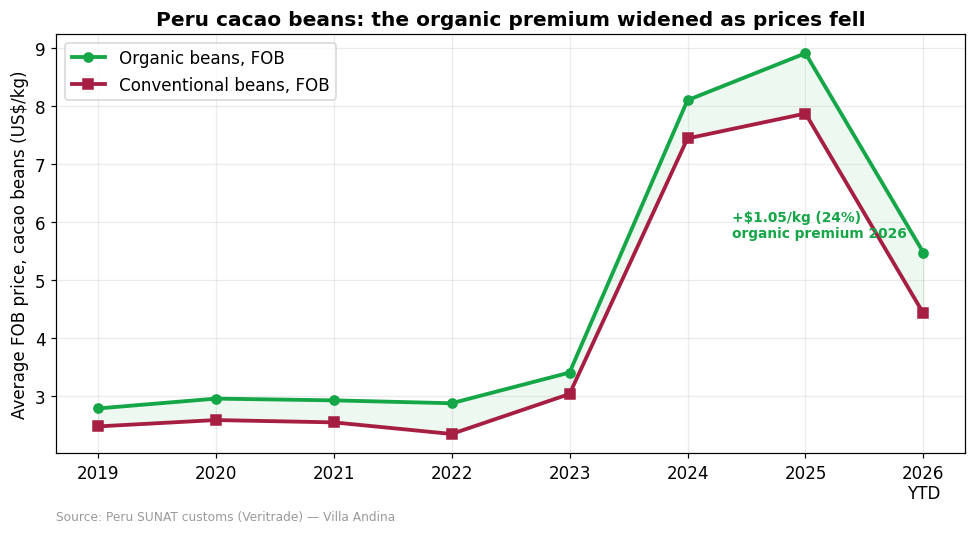
In 2025 organic beans earned about US$1.04 per kilo more than conventional. In 2026 to date the premium is US$1.05 per kilo, but on a much lower base: 24% against 13% last year. When commodity prices fall, certified supply chains hold their value better, because the premium is paid for traceability, certification and quality rather than for the bean itself.
The value-added paradox is reversing
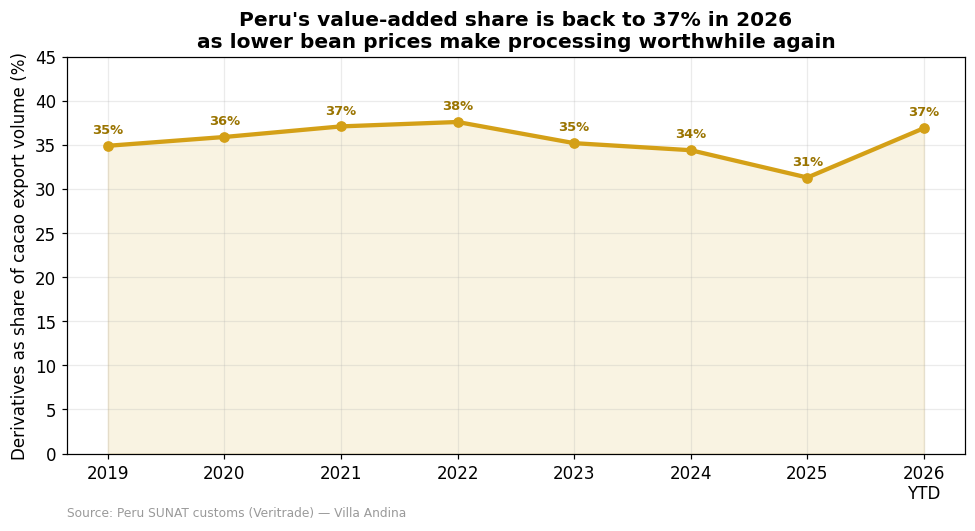
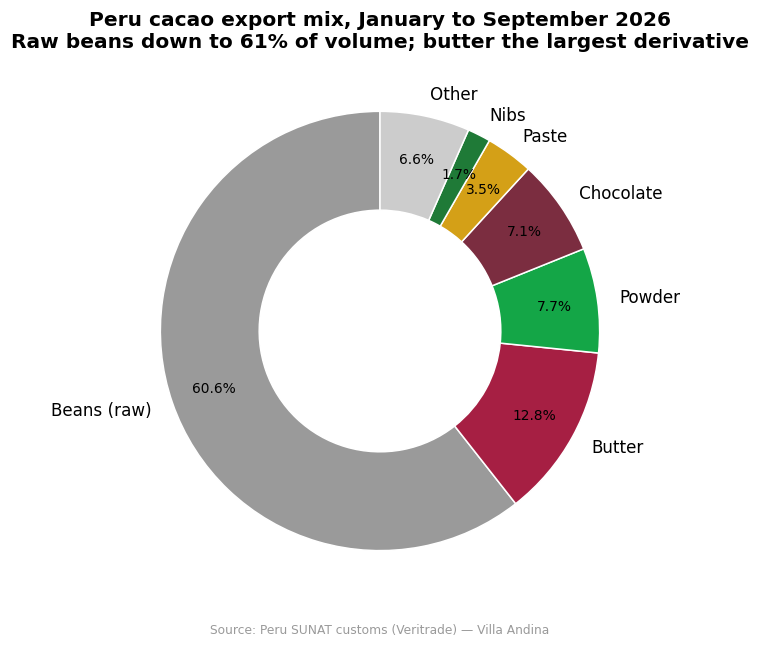
In June we noted that the 2024 price spike had pushed Peru back toward shipping raw beans, with derivatives falling to 31% of export volume in 2025. We expected that to reverse as bean prices normalised, and it has: derivatives are 37% of volume in 2026 to date, back to the 2021-2022 level. Butter is now the largest derivative at 13% of volume, followed by powder and chocolate. This is the segment where Villa Andina operates: organic nibs, paste, butter and powder rather than commodity beans.
Where it goes
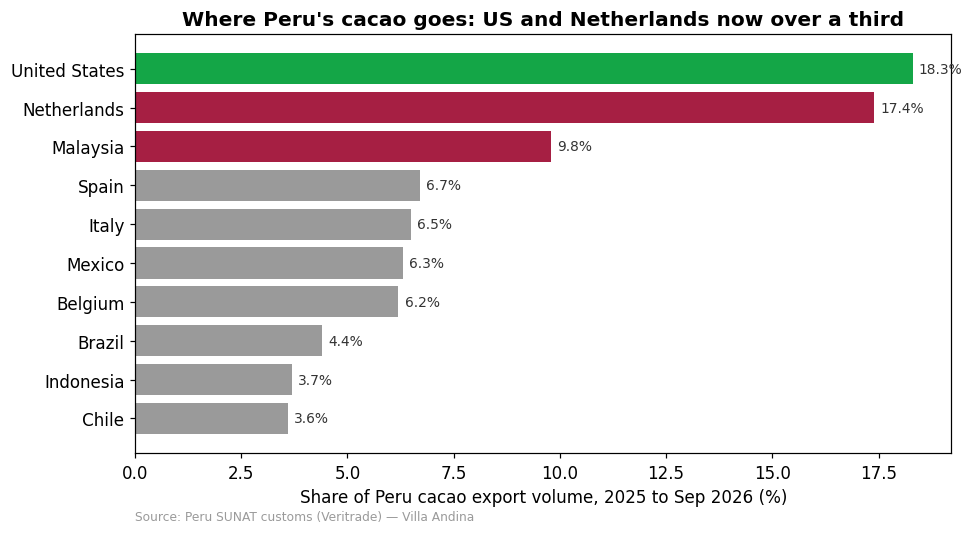
The United States (18%) and the Netherlands (17%) took more than a third of Peru's cacao exports over 2025 and 2026, with Malaysia, Spain, Italy, Mexico and Belgium behind them. Europe and North America together dominate, which matters for freight planning, organic certification and, for powder bound for the EU, cadmium compliance, where Peruvian origin tends to sit comfortably under the limit.
4. Peru's own El Niño: why timing matters this year
El Niño reaches Peru directly. The national El Niño committee, ENFEN, confirmed on 14 September that the coastal El Niño is most likely to reach its highest category, "extraordinary", between September and January, and to last until around April 2027. It expects above-normal rain on the north coast, with moderate to strong episodes from November, about two months earlier than the normal January-to-March rainy season. ENFEN updates its outlook on 28 September.
For cacao the mechanism is not "more rain on every farm". ENFEN expects normal to below-normal rain in parts of the Amazon, where most Peruvian cacao grows. The exposure is in the north: smallholders ferment beans in wooden boxes and dry them in the sun, so persistent rain means poorly dried beans and mould risk; heat and humidity favour pod diseases; and the roads that bring beans from the growing regions across the northern Andes to the coast, and the processing and port corridor around Piura, Lambayeque and Paita, are exactly where ENFEN places the heavy rain. In 1983 and 1998 the north lost roads and bridges for weeks.
Peru's October-to-December harvest overlaps with that forecast. Cacao that is bought, fermented, dried, processed and shipped before the rains set in is cacao where quality and delivery dates can be guaranteed. After that, drying conditions and transit times depend on the weather.
5. What this means for cacao buyers
The pullback is the window. The market is offering cocoa 20% below the August high while every forward-looking supply indicator has deteriorated. Cover taken in the mid-5,000s is cover taken at the low end of the range, before the arrivals data and the Harmattan are known.
Ship before November where you can. For Peruvian origin, the weeks before the forecast rains are the ones where well-dried beans can be sourced and shipped without weather risk. For later deliveries, agreeing volumes now lets the raw material be bought and dried while conditions are good.
Certified and value-added is where Peru's edge is. The organic premium has widened in percentage terms, the derivative segment is growing again, and Peruvian origin runs low on cadmium relative to the EU limit that applies to powder and chocolate.
We are an organic superfoods producer and exporter from Peru, working directly with farming communities. You can explore our organic cacao, our wider superfoods range, and our full product list, all fully traceable.
Frequently asked questions
Why did cocoa prices fall in September 2026? Because the crop that just ended was large. Côte d'Ivoire harvested about 2.06 million tonnes, 30% more than the year before, port deliveries ran 18% ahead of the prior season, and exchange stocks reached a two-year high. Traders sold the comfortable present even as forecasts for the next crop got worse.
Will the 2026/27 West African cocoa harvest be good? No source we consider reliable expects a good one. Reuters surveys of pod counters point to an Ivorian main crop of 1.35 to 1.45 million tonnes, down more than 10%, and Ghana's marketing company expects 470,000 to 620,000 tonnes, down 18% to 38%. Heavy rain in May and June, black pod disease, a 57% farmgate price cut in Côte d'Ivoire and a record El Niño are the reasons.
What does El Niño do to cocoa prices? In West Africa, El Niño years usually bring a hotter and drier Harmattan season from November to February, which cuts the late main crop and the mid-crop. The 2023/24 El Niño was one cause of the 2024 price spike. NOAA gives a more than 90% chance of a very strong El Niño this winter.
Is organic cacao more expensive than conventional? Yes. In Peru, organic beans earned about US$1.05 per kilo more than conventional in 2026 to date, a premium of 24%, up from 13% in 2025 as commodity prices fell.
When is the Peruvian cacao harvest? Peru harvests cacao across the year with a main crop from April to September and a second crop from October to December. Exports normally peak from July to October. In 2026 the peak came earlier and July to August shipments were smaller than in 2025.
Key terms
ICE CC=F. The New York cocoa futures contract, the global reference price in US$ per tonne.
Main crop and mid-crop. West Africa's two harvests. The larger main crop runs roughly October to March; the smaller mid-crop April to September. Côte d'Ivoire moved the start of its marketing year to 1 September in 2026.
Pod counters. Field teams that count pods and flowers on sample trees before the harvest to estimate the coming crop.
Harmattan. The dry, dusty wind from the Sahara that blows over West Africa from about November to February. A strong Harmattan stresses cocoa trees and shrinks the late harvest.
Grindings. The amount of cocoa processed into liquor, butter and powder. The best proxy for real demand.
ENFEN. Peru's multi-sector committee for the study of El Niño, which issues the official national outlook.
FOB. Free On Board, the price of goods loaded at the export port, before freight and insurance.
Technical appendix: for the trading desk
Method. Spot anchor ICE CC=F US$5,307 per tonne (21 September, December now the front month), -11.5% week on week, -11.4% month on month, +16.8% over three months; 12-month range 2,798 to 7,048. Centrals US$5,400, 5,600 and 6,000 at one, three and six months. Realised 90-day volatility is about 62% annualised; the ranges are the central multiplied by exp(±sigma), with sigma scaled by the square root of time (about 18% at one month, 31% at three, 44% at six). Versus our August note the one-month central is US$600 lower and the three-month US$300 lower: the squeeze premium is gone and the tape is heavy, while the next-crop problem has moved from a regulator's warning to survey evidence in both countries plus several independent balance downgrades. The six-month central is US$200 higher for the same reason. Our August one-month central was 6,000 for 4 September; the market closed 6,082 that day.
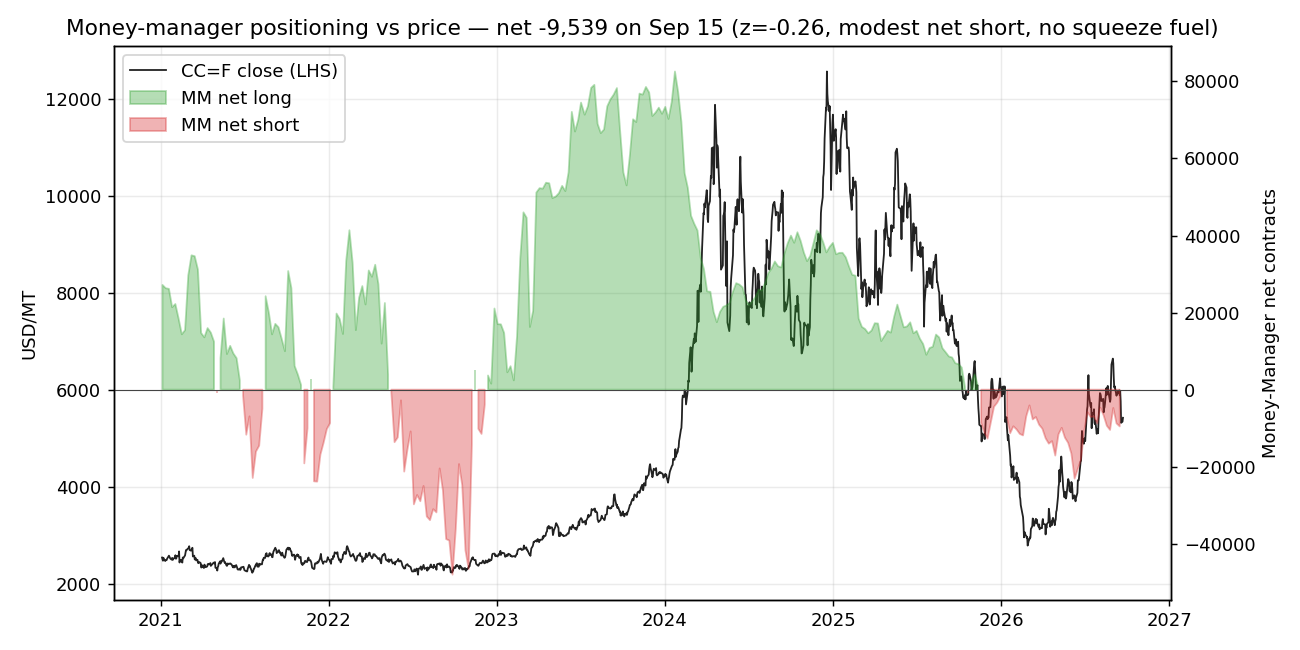
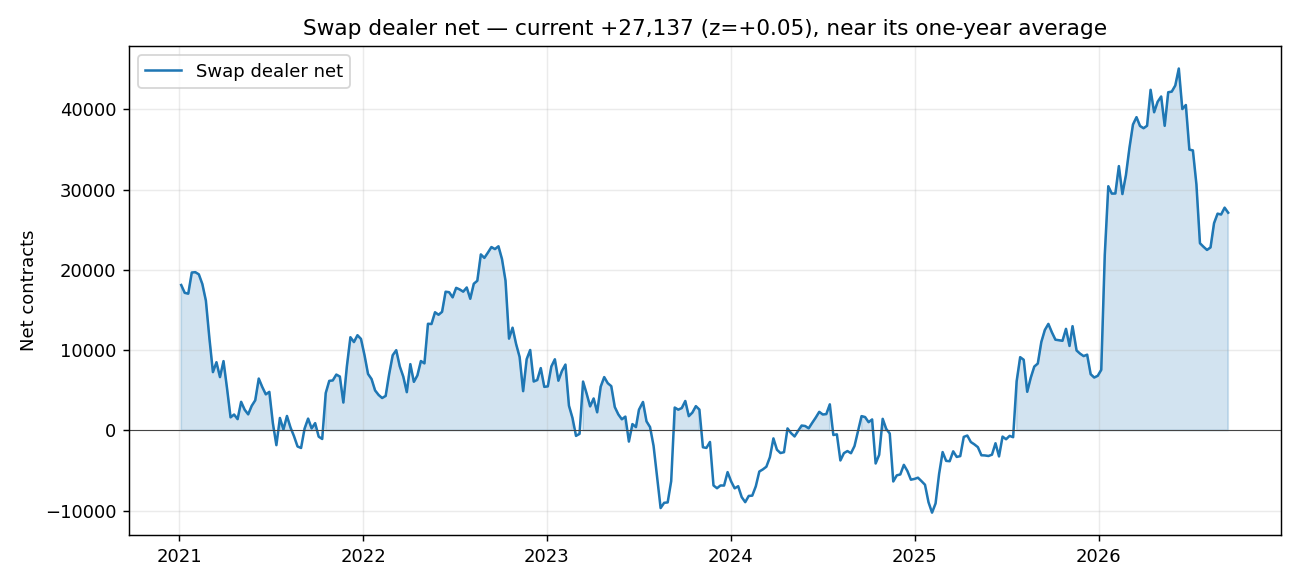
Positioning. Managed money was net short about 9,500 contracts on 15 September (z -0.3) with the long share of open interest at 12.4% (z -0.7). Swap dealers are near their one-year average (+27,100) and commercials moderately short (-23,700, z -0.8) after hedging into the August high. Open interest rebuilt to about 184,000 contracts on 16 September, 7% above its late-August low, so the sell-off came with new positions rather than liquidation. Unlike June and late July there is no loaded short to squeeze. ICE New York certified stocks stand near 205,000 tonnes (z +0.7). Macro is cost-push: Brent above US$130 and the 10-year Treasury yield above 5%, with a soft dollar.
On the model. We also run a gradient-boosted-trees model on a monthly panel of price, positioning, weather and macro features. It does not beat a simple random walk out of sample at the three-month horizon (mean absolute error 15.5% versus 14.1%), which is normal for commodity prices, so we use its uncertainty band and driver attribution rather than its point estimate. From the August month-end base of 6,650 its 10th-to-90th percentile band is roughly US$5,470 to 8,440, so spot has fallen below what the model's regime supports. Its most influential drivers this month are the ENSO index, soil moisture, distance from the 12-month average, the three-month change in ICE stocks and rainfall anomaly: weather forward, inventories now. Methodology and sources available on request.
This article is a market read for general information, not investment advice. Prices move daily; all figures are as of 21 September 2026 unless stated. Global price, positioning and balance data are sourced from ICE, the CFTC and the ICCO; weather data from CHIRPS, NASA POWER and NOAA; the Peru El Niño outlook from ENFEN Comunicado Oficial N° 16-2026; Peru export statistics from SUNAT customs records via Veritrade (September 2026 partial).