The winter that decides Peru's mango crop is over, and the first fruit of the 2026/27 campaign is being picked. This is the final report of the series we started in June and continued in July. It closes the forecast with the complete temperature record, and then turns to what matters from here: the ocean, the rain, how the campaign has opened in the export data, and what fruit is costing at our plant.
The short version
Zero cold nights. The June to August flowering window closed without a single cold night in Piura. The coldest night of the whole winter was 19.5 °C, against a threshold of 18 °C.
An ocean that is still warming. The sea off northern Peru was 4.69 °C above normal in September and has warmed every month since January. That is above every month of the 1997/98 El Niño in the same index.
About 103 million kg. That is our estimate for 2026/27 fresh exports, with a band of 22 to 173, against 242 million kg last campaign and 83 in the 2023/24 collapse.
An expensive opening. Peru's September fresh exports averaged US$ 3.27 per kg FOB, the highest September in our records.
Fruit is available and getting dearer. We could have bought mango at S/ 1.80 per kg in early September; organic fruit is now S/ 2.40 per kg at our plant in Chiclayo.
Why cold nights decide the campaign
Kent, the variety behind most of Peru's mango exports, flowers only after a period of floral induction, and induction needs cold nights during the southern winter. The working threshold used by growers and agronomists is an overnight minimum at or below 18 °C between June and August. When a winter delivers 60 to 90 such nights, the valleys flower massively and the campaign is large. When a coastal El Niño keeps the nights warm, the trees do not flower, and there is little that irrigation or crop management can do about it. The July report explains the mechanism in more detail; this one records how the winter ended.
The final winter record: zero cold nights
We track the overnight minimum every day at the San Lorenzo valley grid cell in Piura, using ECMWF ERA5 reanalysis data. The blue line is 2026. On 89 of the 92 nights of the winter it ran above the normal range of the previous twelve years (the grey band), on 73 of them it was the warmest night on record for that date, and it never touched the threshold.
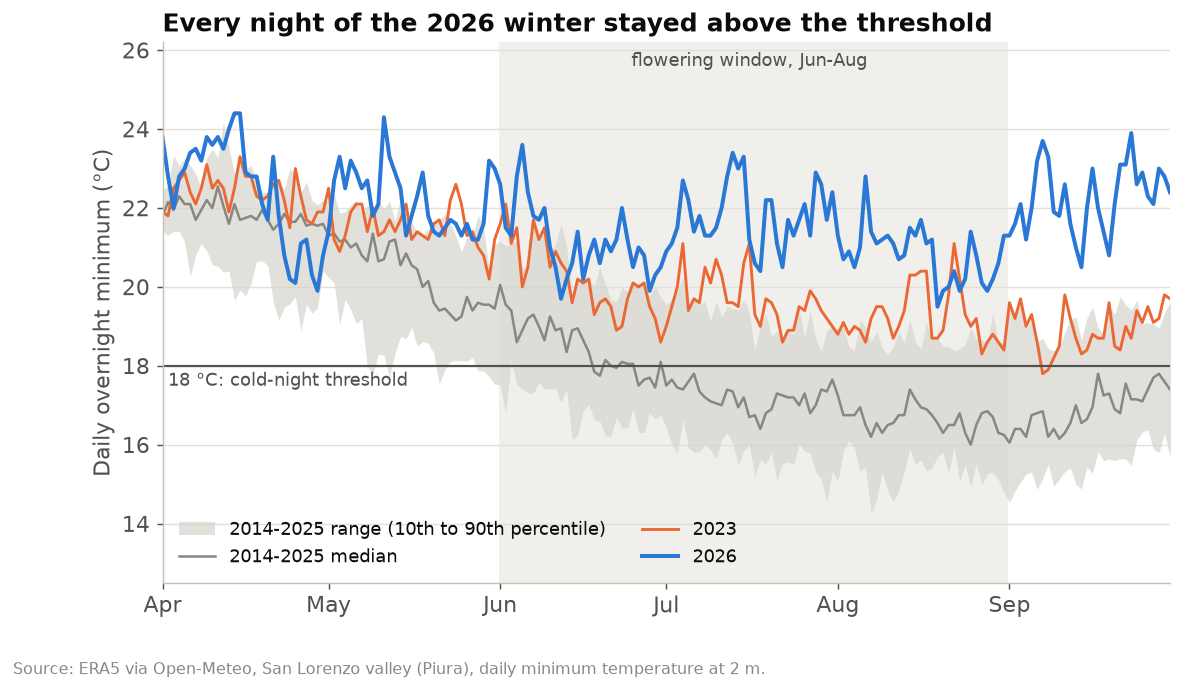
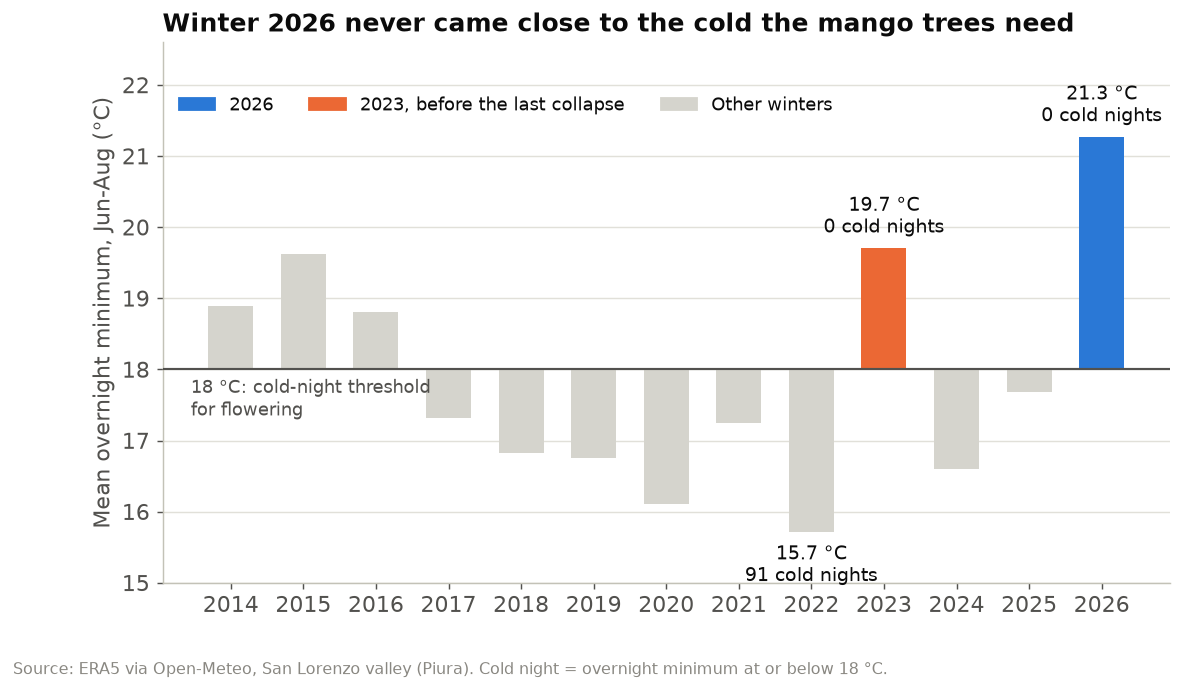
The average overnight minimum from June to August was 21.3 °C. That is 1.6 °C warmer than 2023, the only other winter in our records with zero cold nights, and 3.3 °C above the threshold. For comparison, in a typical winter around 72 of the 92 nights between June and August are cold nights.
Mean overnight minimum by month (°C)
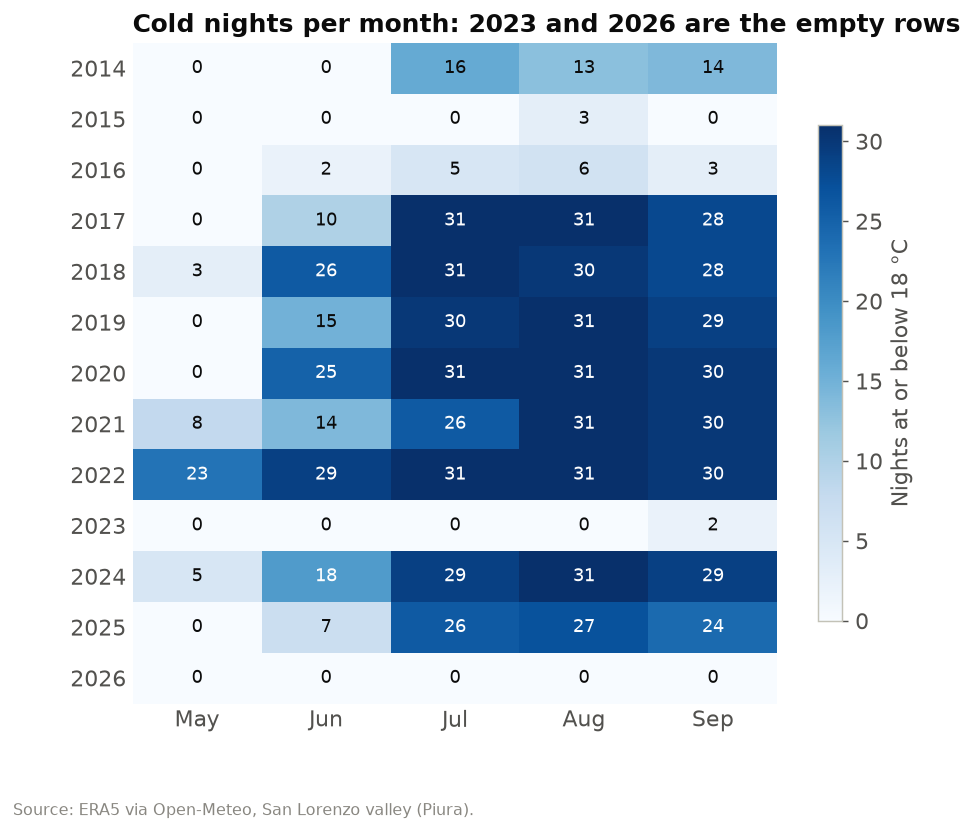
San Lorenzo valley, May to September. Every 2026 month is the warmest of its column in the series, and September was warmer than any of the three winter months.
| Year | May | Jun | Jul | Aug | Sep |
|---|---|---|---|---|---|
| 2014 | 21.5 | 20.4 | 18.3 | 18.0 | 18.1 |
| 2015 | 21.9 | 20.9 | 19.4 | 18.6 | 19.6 |
| 2016 | 21.1 | 19.4 | 18.5 | 18.5 | 18.8 |
| 2017 | 20.4 | 18.5 | 16.9 | 16.6 | 16.7 |
| 2018 | 19.4 | 17.2 | 16.7 | 16.5 | 16.9 |
| 2019 | 20.4 | 18.0 | 16.6 | 15.7 | 16.5 |
| 2020 | 20.3 | 17.2 | 16.0 | 15.2 | 15.6 |
| 2021 | 18.5 | 18.1 | 17.2 | 16.5 | 16.2 |
| 2022 | 17.5 | 16.1 | 15.7 | 15.3 | 15.3 |
| 2023 | 21.5 | 20.2 | 19.7 | 19.2 | 18.9 |
| 2024 | 19.6 | 17.6 | 16.3 | 16.0 | 16.3 |
| 2025 | 19.7 | 19.0 | 17.2 | 16.8 | 17.0 |
| 2026 | 22.2 | 21.2 | 21.8 | 20.8 | 22.2 |
Cold nights per month (overnight minimum at or below 18 °C)
| Year | May | Jun | Jul | Aug | Sep |
|---|---|---|---|---|---|
| 2014 | 0 | 0 | 16 | 13 | 14 |
| 2015 | 0 | 0 | 0 | 3 | 0 |
| 2016 | 0 | 2 | 5 | 6 | 3 |
| 2017 | 0 | 10 | 31 | 31 | 28 |
| 2018 | 3 | 26 | 31 | 30 | 28 |
| 2019 | 0 | 15 | 30 | 31 | 29 |
| 2020 | 0 | 25 | 31 | 31 | 30 |
| 2021 | 8 | 14 | 26 | 31 | 30 |
| 2022 | 23 | 29 | 31 | 31 | 30 |
| 2023 | 0 | 0 | 0 | 0 | 2 |
| 2024 | 5 | 18 | 29 | 31 | 29 |
| 2025 | 0 | 7 | 26 | 27 | 24 |
| 2026 | 0 | 0 | 0 | 0 | 0 |
Each winter and the campaign that followed
The coldest-night column shows how far this winter was from normal. In most years the coldest night lands between 13 and 16 °C, well below the threshold. In 2026 it was 19.5 °C, so not one night came close.
| Winter | Nights ≤ 18 °C (Jun-Aug) | Nights ≤ 16 °C | Mean minimum (°C) | Coldest night (°C) | Following campaign (M kg) | Campaign FOB (US$/kg) |
|---|---|---|---|---|---|---|
| 2014 | 29 | 0 | 18.9 | 16.8 | 106.5 | 1.55 |
| 2015 | 3 | 0 | 19.6 | 17.8 | 128.6 | 1.29 |
| 2016 | 13 | 0 | 18.8 | 17.4 | 180.8 | 1.11 |
| 2017 | 72 | 8 | 17.3 | 15.4 | 204.2 | 1.19 |
| 2018 | 87 | 13 | 16.8 | 15.4 | 178.1 | 1.31 |
| 2019 | 76 | 25 | 16.8 | 13.6 | 248.5 | 1.12 |
| 2020 | 87 | 44 | 16.1 | 14.2 | 231.7 | 1.23 |
| 2021 | 71 | 9 | 17.2 | 15.4 | 240.1 | 1.19 |
| 2022 | 91 | 67 | 15.7 | 14.1 | 262.8 | 1.12 |
| 2023 | 0 | 0 | 19.7 | 18.3 | 83.1 | 2.73 |
| 2024 | 78 | 34 | 16.6 | 14.4 | 377.8 | 1.11 |
| 2025 | 60 | 9 | 17.7 | 15.1 | 242.4 | 1.54 |
| 2026 | 0 | 0 | 21.3 | 19.5 | 103 (estimate, 22 to 173) | in progress |
The ocean: above 1997/98, and still warming
Piura's winter nights are cooled by the cold water of the Humboldt current offshore. When that strip of ocean runs warm, the nights follow. NOAA's Niño 1+2 index measures that strip, and this is where 2026 parts from 2023. Three years ago the coastal El Niño peaked in August at +3.30 °C and was fading by the time the fruit was picked. This year the anomaly reached +4.69 °C in September and has risen every month since January.
September 2026 is also above every month of the 1997/98 El Niño in this same index, where the highest reading was +3.73 °C. It is the highest monthly value in the NOAA series, which starts in 1982.
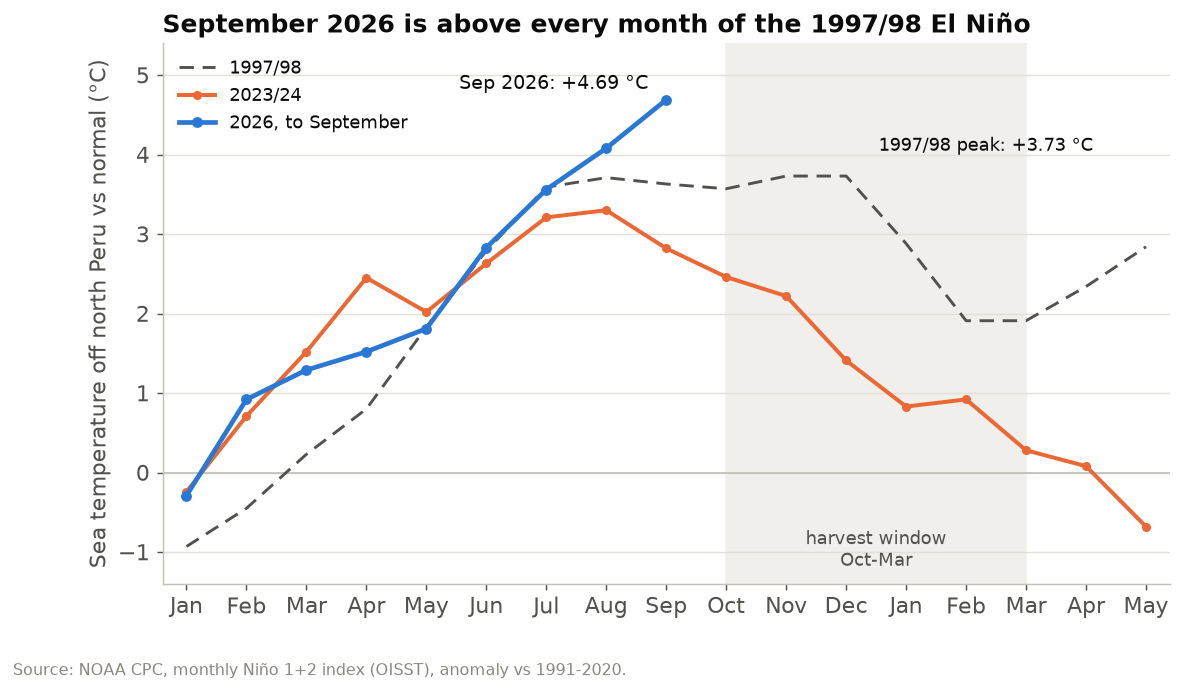
Monthly sea temperature anomaly off northern Peru (°C against the 1991 to 2020 average). ICEN is Peru's official coastal index; it is a three-month average and is published about two months behind, which is why it stops in July.
| Month | Niño 1+2, 2026 | ICEN 2026 (official) | Niño 1+2, 2023 | Niño 1+2, 1997 |
|---|---|---|---|---|
| Jan | -0.29 | -0.06 | -0.24 | -0.93 |
| Feb | +0.92 | +0.42 | +0.71 | -0.45 |
| Mar | +1.29 | +0.96 | +1.52 | +0.23 |
| Apr | +1.52 | +1.34 | +2.45 | +0.80 |
| May | +1.81 | +1.98 | +2.02 | +1.83 |
| Jun | +2.83 | +2.66 | +2.63 | +2.79 |
| Jul | +3.56 | +3.38 | +3.21 | +3.59 |
| Aug | +4.08 | pending | +3.30 | +3.71 |
| Sep | +4.69 | pending | +2.82 | +3.63 |
| Oct | +2.46 | +3.57 | ||
| Nov | +2.22 | +3.73 | ||
| Dec | +1.41 | +3.73 |
In its Comunicado Oficial N° 17-2026 of 28 September, ENFEN, Peru's official El Niño commission, keeps the Coastal El Niño Alert and expects the event to hold at extraordinary magnitude until January 2027, weakening toward the autumn. Its outlook for the months of the harvest:
October to December: above-normal rain on the north coast, the central coast and the western valleys of the northern Andes, with moderate to strong episodes not ruled out, mainly on the north coast, like those already recorded in Tumbes. River flows above normal in the Tumbes, Chira, Piura, La Leche and Jequetepeque basins.
Summer 2027: above-normal rain on the north coast, the central coast and the north-western highlands.
Air temperature: far above normal along the whole coast, with a high probability of new records.
ENFEN publishes its next comunicado on 15 October.
Rain: the risk that 2023/24 did not have
The 2023/24 campaign was small, but it was not chaotic. The ocean had cooled before the harvest, the summer of 2024 brought 241 mm of rain between January and March, an ordinary season, and the little fruit there was came out clean and on time. This year the forecast keeps the event at full strength through the harvest. In the 2017 coastal El Niño the same three months brought 1,393 mm.
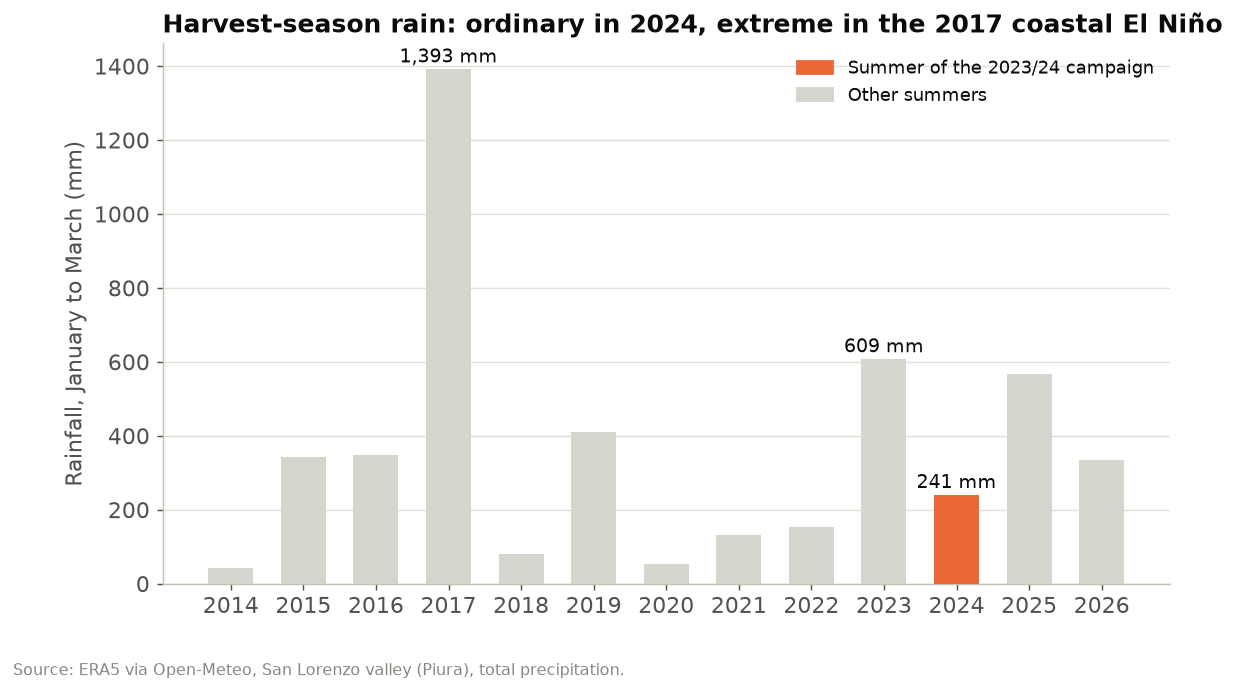
When it rains hard in Piura and Lambayeque, picking stops and the fruit cannot get out. Mango specialist Milton Calle puts numbers on it: about a third of Piura's production is harvested between week 52 and week 3, the period of greatest logistical risk because of waterlogged soils, damaged roads and daily rainfall that could exceed 50 mm, and even light rain in November could affect up to 30% of the fruit through anthracnose (FreshPlaza, 16 September). So the risk this season is a small crop and an interrupted harvest at the same time.
What it means in volume
Across the twelve completed campaigns since 2014/15, each additional cold night in the winter has been worth roughly 1.7 million kg of fresh exports in the campaign that followed, and the count of cold nights alone explains about half of the variation between campaigns (R² = 0.53).
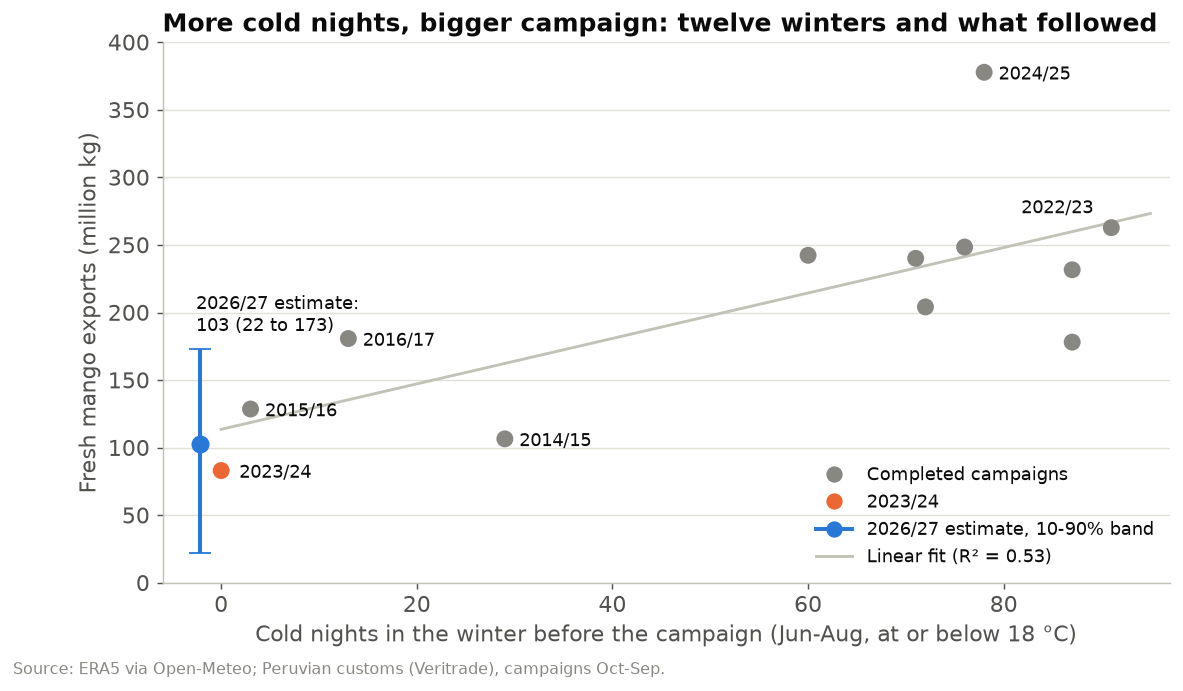
In July we published four scenarios weighted by ENFEN's probabilities. With the winter closed they collapse into one. Our estimate for 2026/27 is roughly 103 million kg of fresh mango exports, with an uncertainty band of 22 to 173. Last campaign closed at 242 million kg, the average of the last five is 241, and the 2023/24 collapse was 83.
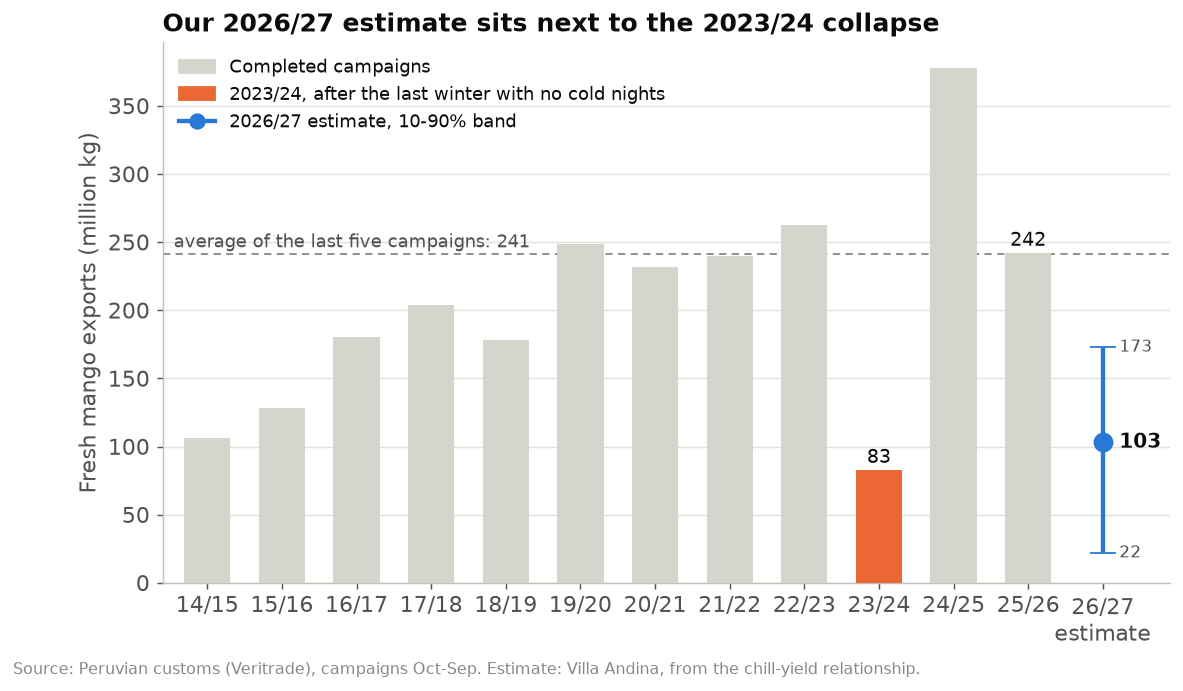
People who walk the orchards arrive at similar numbers. Promango estimates national production at about 179,000 tonnes against 557,000 in a normal year (Portal Frutícola, 29 September). Milton Calle expects national production to fall by about 60% against last year, with Motupe, Olmos and Piura hit hardest between December and January, and flowering in Casma at around 10%, rising to perhaps 20% by the end of September.
How the campaign has opened
What is being picked now are the early varieties, mainly Edward and Haden, which handled the heat better than Kent. In the zones we buy from, Edward runs until about December and Haden until January. They come from a much smaller base than Kent, and fresh exporters, freezers, pulp plants and dryers all buy from it.
Customs data shows the result. Peru exported 583 tonnes of fresh mango in September at an average of US$ 3.27 per kg FOB, the highest September in our records. Canada took 255 tonnes, Spain 156 and the Netherlands 81.
| September | Fresh mango exported (tonnes) | Average FOB (US$/kg) |
|---|---|---|
| 2019 | 63 | 1.26 |
| 2020 | 543 | 1.26 |
| 2021 | 617 | 1.06 |
| 2022 | 73 | 1.74 |
| 2023 | 278 | 2.09 |
| 2024 | 866 | 2.14 |
| 2025 | 232 | 2.74 |
| 2026 | 583 | 3.27 |
The price dip that never came in 2023/24
Many buyers plan around the price dip that normally arrives with peak supply in December and January. In 2023/24 it did not arrive. The average FOB opened at US$ 2.59 in October, was 2.74 in December, 2.84 in January and 4.19 in April. Whoever waited for December paid more than whoever bought in October.
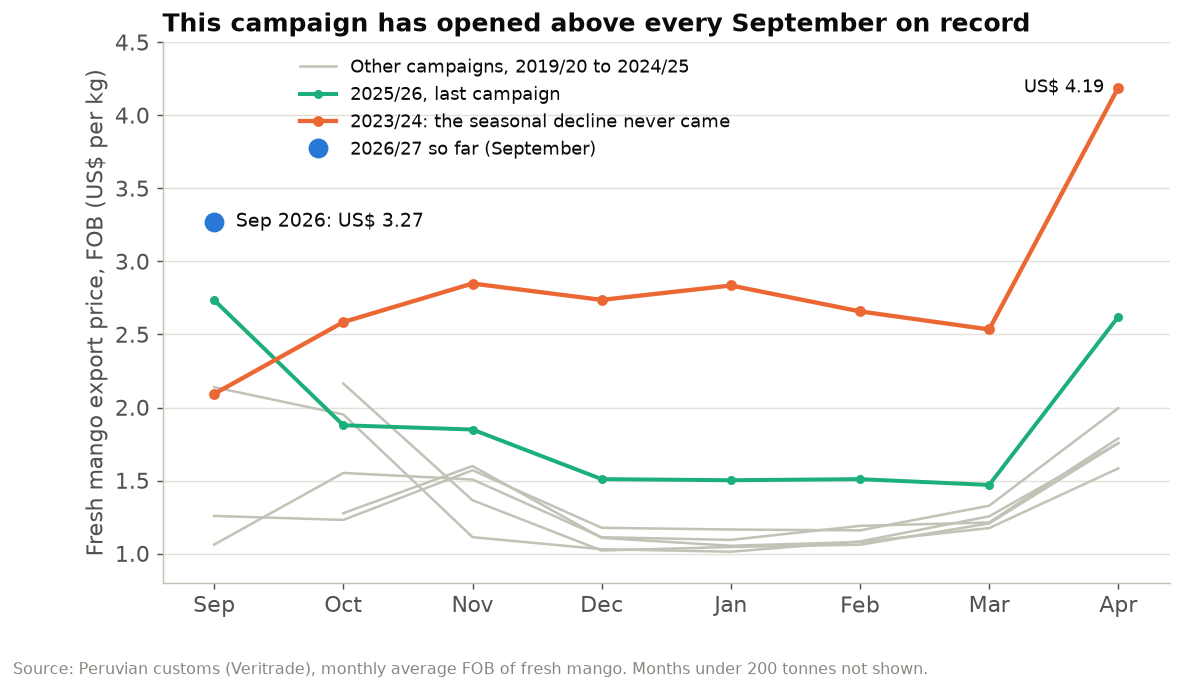
Average FOB of fresh mango by campaign month (US$ per kg). Months with less than 200 tonnes exported are left blank.
| Campaign | Sep | Oct | Nov | Dec | Jan | Feb | Mar | Apr |
|---|---|---|---|---|---|---|---|---|
| 2019/20 | 1.28 | 1.60 | 1.11 | 1.05 | 1.08 | 1.17 | 1.58 | |
| 2020/21 | 1.26 | 1.23 | 1.57 | 1.18 | 1.16 | 1.16 | 1.33 | 2.00 |
| 2021/22 | 1.06 | 1.55 | 1.51 | 1.11 | 1.09 | 1.19 | 1.21 | 1.79 |
| 2022/23 | 2.16 | 1.37 | 1.02 | 1.05 | 1.06 | 1.21 | 1.76 | |
| 2023/24 | 2.09 | 2.59 | 2.85 | 2.74 | 2.84 | 2.66 | 2.53 | 4.19 |
| 2024/25 | 2.14 | 1.95 | 1.11 | 1.03 | 1.01 | 1.08 | 1.26 | 1.76 |
| 2025/26 | 2.74 | 1.88 | 1.85 | 1.51 | 1.50 | 1.51 | 1.47 | 2.62 |
| 2026/27 | 3.27 |
Dried mango in a short year
Dried mango went the same way. Peru shipped 73 tonnes of organic dried mango in the whole 2023/24 campaign, against 1,001 tonnes the year after and about 1,830 last campaign. By then the question for buyers was no longer the price, it was whether there was product.
| Campaign | Organic dried mango exported (tonnes) | Average FOB (US$/kg) |
|---|---|---|
| 2019/20 | 164 | 12.15 |
| 2020/21 | 378 | 6.50 |
| 2021/22 | 406 | 9.77 |
| 2022/23 | 211 | 9.77 |
| 2023/24 | 73 | 10.78 |
| 2024/25 | 1,001 | 10.35 |
| 2025/26 | 1,830 | 9.14 |
Bottom line
The harvest has begun. Mango has been available since the first week of September, and the volume in the fields has increased continuously since then. Prices have not come down with it. In the first weeks of September we could have purchased mango at S/ 1.80 per kg, and today organic mango is S/ 2.40 per kg at our plant in Chiclayo. Prices could continue to increase as more of the industry, the frozen (IQF) plants in particular, begins buying industrial grade mango.
For dried mango the arithmetic is simple: about 10 kg of fresh fruit go into 1 kg of product, so every S/ 0.10 per kg on the fruit is worth close to US$ 0.30 per kg of dried mango. Offers this season will follow the fruit week by week, and the coming weeks, before the rains ENFEN expects, are the ones in which we can process with the most confidence.
Our fruit comes from three regions in northern Peru: the San Lorenzo valley and Chulucanas in Piura, Olmos and Motupe in Lambayeque, and the Payac valley in Cajamarca. If you have dried mango needs for this campaign, please share your volumes and timing with us at pmartinto@villaandina.com and we will tell you what we can commit to and at what price that week.
What happens next
This closes our 2026/27 forecast series. From here the harvest tells the story, and we will follow it in our monthly market update. The markers we are watching, in order: the weekly fruit price at origin, the first October export weeks in customs data, the rain episodes on the north coast, and ENFEN's comunicado of 15 October.
Methodology and sources
Temperature and rainfall: ECMWF ERA5 reanalysis for the San Lorenzo valley grid cell, via the Open-Meteo historical archive. Export volumes and prices: Peruvian customs records (Veritrade), campaigns defined October through September. Ocean: NOAA Climate Prediction Center monthly Niño 1+2 index (OISST), anomalies against 1991 to 2020; our July report used NOAA's ERSSTv5 version of the same index, which has not been updated since June, so the early 2026 values differ by a few tenths of a degree. ICEN from IGP. Forecasts: ENFEN Comunicado Oficial N° 17-2026 (28 September 2026).
The volume estimate is arithmetic from the observed relationship between cold nights and yield over twelve campaigns, adjusted for planted area. In cross-validation our statistical model does not beat a simple median baseline on a sample this small, so please read it as an order of magnitude, not a precise figure. Planted-area figures are our own estimates pending verification against MIDAGRI data. Field prices are what we see in our own buying and they move every week. Charts and tables were generated from our data warehouse on 6 October 2026.
Villa Andina is an organic superfoods manufacturer and exporter based in Peru. We produce dried mango, banana, pineapple and goldenberry, cacao derivatives, maca and Andean grains for industrial and retail customers in North America, Europe and Asia. If you would like to receive these updates by email, write to us at pmartinto@villaandina.com.